


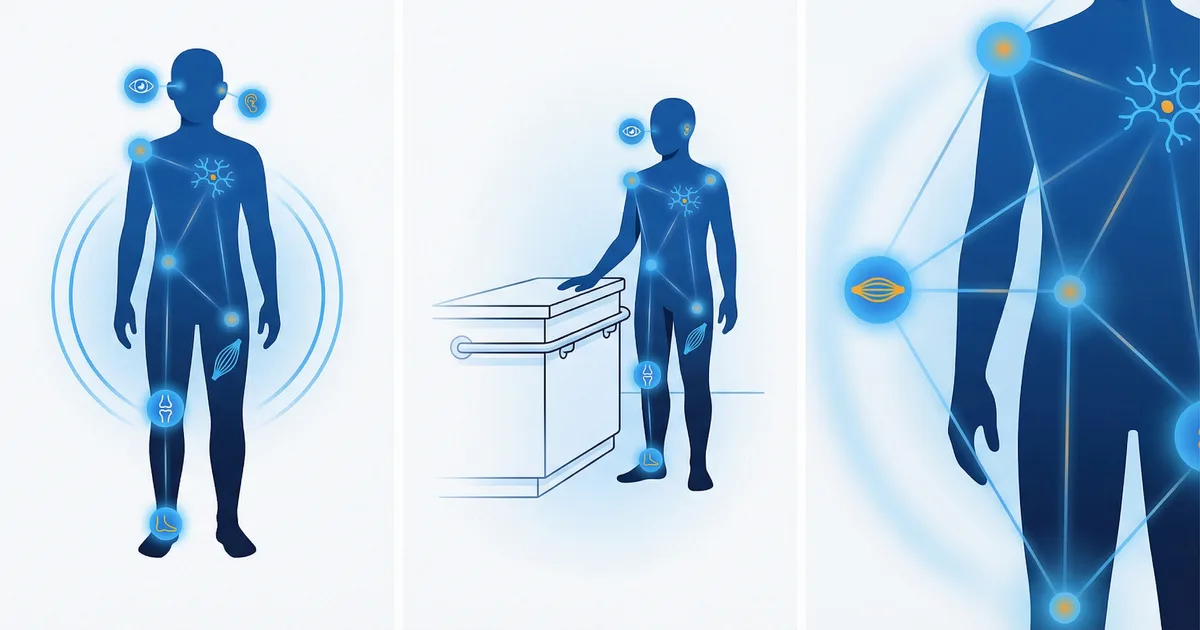
Balance is something most of us take for granted until it's lost. But what exactly allows us to stand, walk, and move without falling? The answer lies in a complex interplay of systems within our bodies—each as critical as the next. First, we will talk about the sensors detecting movement of the body or its surroundings (inputs in engineering speak), and next, the neuromuscular control system (outputs in engineering speak) for responding to these triggers. Finally, we will talk about the Central Nervous System (CNS), which is the command center that coordinates sensory inputs and triggers motor outputs from your muscles.
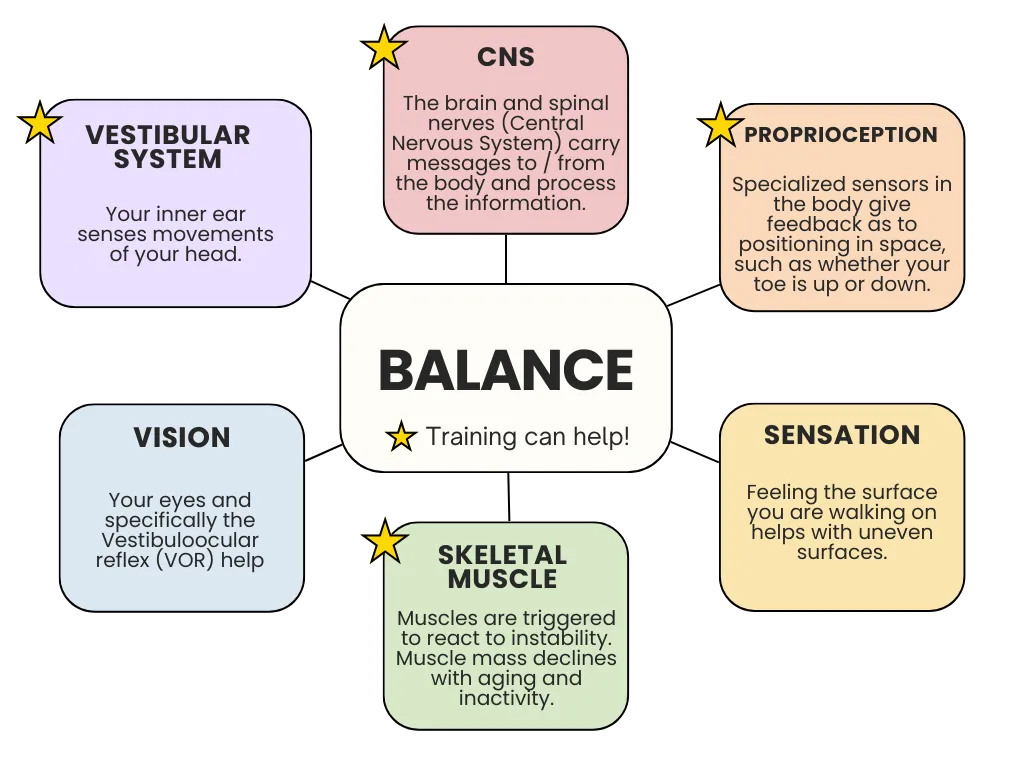
The 6 Body Systems Critical to Balance: Vision, Sensation, Vestibular, Proprioception, CNS, and Musculoskeletal
Vision: The Guiding Light
Our eyes provide critical information about our environment. Visual input helps us anticipate obstacles, judge distances, and navigate safely. In low-light conditions or with visual impairments, the burden on the other systems increases.
The Romberg test, a simple clinical assessment, illustrates this reliance. By standing with feet together and eyes closed, individuals with balance issues may sway or fall, revealing how much they depend on vision for stability. Yet for most individuals, this test is more of a proof that balance relies on more than just vision – try it now by standing with your feet together and eyes closed. If you can successfully do so, then we have now proven that vision is not always critical to your balance. So, keep reading to learn more.
The Vestibular System: The Inner Ear's Gyroscope
Within our inner ears resides the vestibular system, the body's gyroscope. Each ear has 3 fluid-filled canals lined with tiny hair cells that detect motion and changes in head position. When you tilt your head or accelerate, the fluid moves, bending the hair cells and sending signals to the brain about your body's orientation. The brain determines how the head is moving by determining magnitude of hair cell movements in each of the 3 fluid filled canals.
Unfortunately, there's no redundancy. Just one of these 6 canals being disrupted leads to vertigo – the feeling as if the world is spinning. Vertigo is extremely common, with an estimated 40% of the population suffering vertigo at some point in their life (notably, vertigo can be caused by brain tumors or strokes, not just inner ear issues). Fortunately, many causes of vertigo are temporary, though certainly disabling while it lasts.
Sensation
Everyone knows that being able to feel how your feet are planted and pushing off is critical to helping with balance. Yet few outside the medical community recognize how common and easy it is to lose sensation to feet, impairing balance dramatically. Neuropathy is the medical term for nerve dysfunction, which commonly affects sensation first. It starts with the longest nerves in the body, which stretch from your toes all the way up to your spine.
Proprioception: The Body's Sixth Sense
Proprioception is often termed the "sixth sense," though it lacks the mystique of extrasensory perception. It's our innate ability to sense the position and movement of our body parts without visual cues. Specialized receptors in muscles, tendons, and joints send continuous feedback to the CNS about limb positions.
This sense allows you to touch your nose with your eyes closed or adjust your gait without looking at your feet. When proprioception is impaired—due to injury or neuropathy—simple tasks become challenging, increasing the risk of falls. Although related to sensation, proprioception is different. A B12 deficiency, for example, can cause isolated proprioceptive issues leading to balance impairment.
The Central Nervous System: The Command Center
The brain and spinal cord form the central nervous system (CNS). The CNS processes input from the vestibular system, eyes, and proprioceptive/sensory nerves, processing and integrating this information to make split-second decisions. Imagine walking on an uneven surface. Your eyes perceive the terrain, your vestibular system notes any head movements, and proprioceptors in your muscles and joints report limb positions. The CNS synthesizes this data, then sends this data to instruct specific muscles to contract which, in turn, keeps you upright.
Neurological conditions affecting the CNS—such as stroke, Parkinson's disease, or multiple sclerosis—can disrupt this coordination, leading to balance impairments. It underscores the CNS's role as the master integrator in our balance mechanism.
Skeletal Muscle: The Movers and Stabilizers
Muscles do more than move us; they stabilize us. Skeletal muscles respond to signals from the CNS to make minute adjustments in tension, ensuring we don't topple over. This constant, dynamic activity is called postural control. Muscle weakness, whether from aging, inactivity, or illness, reduces this stabilizing force. Without strong muscles to execute the CNS's commands, balance becomes precarious. It's why strength training is vital, not just for mobility but for stability.
The Interplay: A Coordinated Effort
These systems don't operate in isolation. The body's sensors of balance include proprioception, vision, and the vestibular system. If vision is compromised, proprioception and vestibular inputs become more critical. When the vestibular system falters, reliance on vision and proprioception increases.
Consider a dancer performing a spin. They use a technique called "spotting," focusing their gaze on a fixed point to maintain balance during the spin. Here, vision aids the vestibular system, which is momentarily overwhelmed by rapid head movements.
Harnessing Balance Through Training
The good news is that balance isn't a fixed trait; it's a skill that can be improved with training. Exercises targeting the CNS, vestibular system, skeletal muscles, and proprioception can enhance stability. Activities such as dancing and sports can not only assist with balance, but also strength and mobility. Yoga and pilates improve balance and mobility.
Yet dedicated balance training is the best way to see rapid, demonstrable improvements in one's balance, just as a dedicated biceps weightlifting training program improves bicep size more than CrossFit. To learn balance exercises, there are books, YouTube videos, and other resources. But we recommend you check out our app, which tracks your balance and improvement over time.
Conclusion: The Path Forward
Balance is a complex, dynamic process involving multiple systems working in harmony. Understanding the roles of the vestibular system, CNS, proprioception, skeletal muscle, and vision allows us to appreciate this everyday miracle.
As we age or face health challenges, investing time in balance training isn't just about preventing falls—it's about maintaining independence and quality of life. Whether through formal rehabilitation or incorporating balance exercises into daily routines, we have the tools to keep ourselves steady.
In the end, balance is more than just a physical state; it's a reflection of how interconnected our bodies truly are. By nurturing each component, we support the whole, allowing us to navigate the world with confidence and grace.
Ready to start your balance journey? Start with one small, safety-first habit today (2 minutes near a counter), then build from there.