

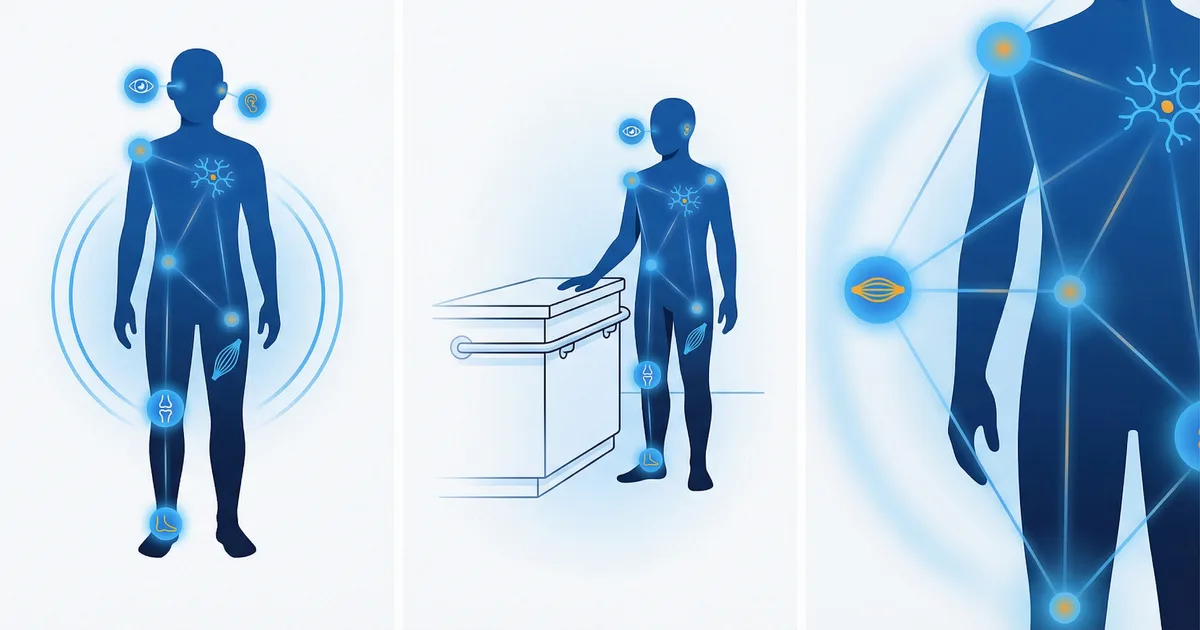
Balance is something most of us take for granted until it feels off. But what actually lets you stand, walk, turn, and recover from a stumble?
The short answer: balance is a coordinated skill. Your brain blends information from your eyes, inner ears, feet, joints, muscles, and nervous system, then sends fast instructions to the muscles that keep you upright.1
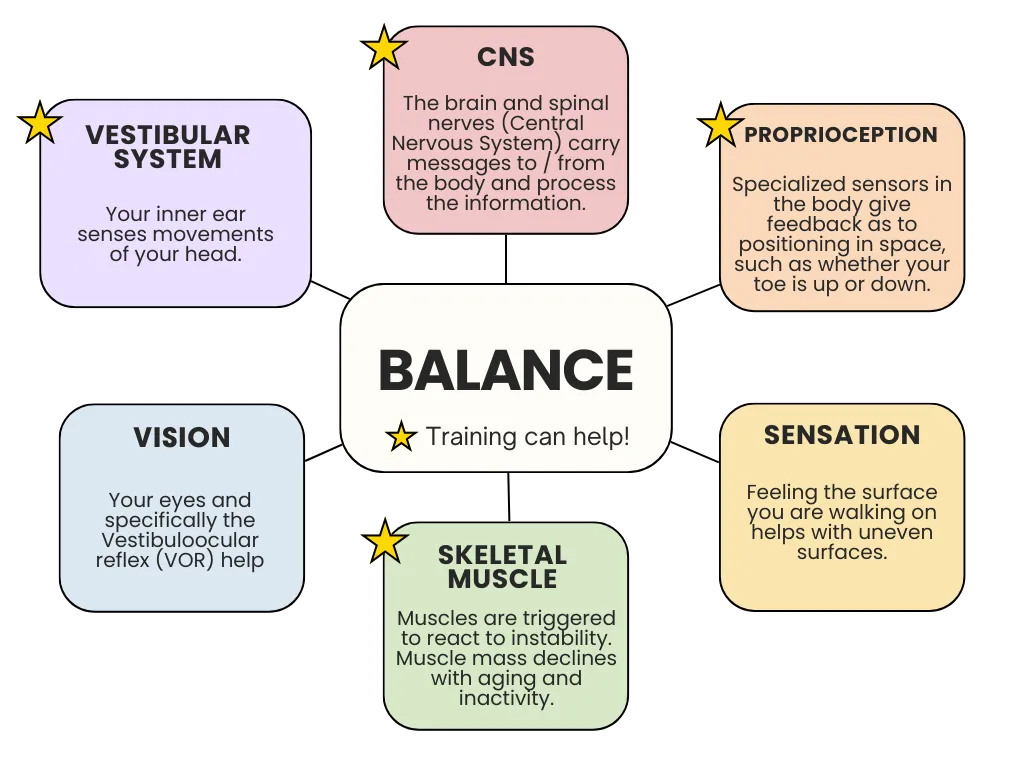
The 6 Body Systems Critical to Balance: Vision, Sensation, Vestibular, Proprioception, CNS, and Musculoskeletal
Quick Take
- Balance is multisensory. Vision, vestibular input, and body-sense signals all help your brain estimate where you are in space.1
- The systems overlap. "Sensation" and "proprioception" are separated here to make the science easier to understand, but they work together in real life.
- A single weak link can change how steady you feel. Dim light, reduced foot sensation, dizziness, or muscle weakness can all shift the load onto the other systems.
- Training should be safe and progressive. Research supports balance-focused exercise and sensory-integration training for improving balance-related performance in older adults, but no article or app can diagnose the cause of new balance symptoms.23
Vision: The Guiding Light
Our eyes provide critical information about the world around us. Visual input helps you anticipate obstacles, judge distance, identify stair edges, and orient your body to a stable reference point. In older adults, visual measures such as contrast sensitivity and depth perception have been linked with postural stability, especially under more challenging standing conditions.4
That is why balance can feel different in dim hallways, on low-contrast stairs, or in visually busy places. If vision gets less reliable, your brain has to lean more on the inner ear and body-sense systems. For a deeper look at this piece of the puzzle, see Vision and Balance: Why Your Eyes Matter More Than You Think.
The Romberg-style eyes-closed stance is one way clinicians explore how much a person relies on vision, but it is not a diagnosis by itself. If you try a home balance check, do it near a counter or sturdy support. The safer walkthrough is here: Simple Balance Tests You Can Do at Home.
The Vestibular System: The Inner Ear's Gyroscope
Deep inside each inner ear is the vestibular system, a set of motion and gravity sensors. Each ear has three semicircular canals that detect rotation, plus otolith organs that help detect tilt and straight-line movement. These structures use tiny hair cells to convert motion into nerve signals your brain can interpret.56
The vestibular system also helps keep your vision stable while your head moves. That is one reason turning quickly, looking up, or walking on uneven ground can feel harder when this system is irritated or less reliable.
Dizziness and balance problems are common, and they can come from the inner ear, the brain, medications, blood pressure, vision, and other causes.6 New, severe, or persistent dizziness deserves medical guidance, especially if it comes with weakness, trouble speaking, severe headache, chest pain, or sudden vision changes. For the related plain-English guide, see The Vestibular System: Your Inner Ear's Role in Balance.
Sensation
"Sensation" here means the basic feeling information coming from your feet and skin: pressure, vibration, touch, and contact with the floor. These signals help your brain answer simple questions: Is the ground firm or soft? Is my weight more on my heel or my toes? Did my foot land where I expected?
The soles of the feet have specialized receptors that help detect pressure and skin stretch during standing and walking.7 When sensation is reduced, balance often becomes more visually dependent. That is one reason dark rooms, thick carpet, or uneven ground can feel much more challenging.
Neuropathy is one medical term for nerve dysfunction that can reduce sensation, often starting in the feet. It has many causes, including diabetes, vitamin deficiencies, medication effects, and other conditions. Population research shows chronic polyneuropathy becomes more common with age and is associated with several health risk factors.8 If you notice new numbness, tingling, burning pain, or loss of foot sensation, bring it up with a clinician.
Proprioception: The Body's Sixth Sense
Proprioception is your sense of body position and movement. It is how you can touch your nose with your eyes closed, step over an object without staring at your feet, or make a quick ankle adjustment when the sidewalk slopes.
Specialized receptors in muscles, tendons, joints, and related tissues send continuous feedback to the central nervous system. Research reviews describe proprioception as age-sensitive, but also adaptable with practice and training.9 When proprioception is impaired by injury, neuropathy, or other medical conditions, small balance corrections can become slower or less accurate.
Although sensation and proprioception are related, separating them is useful. Sensation tells you what the floor feels like. Proprioception tells you where your ankle, knee, hip, trunk, and limbs are moving. For more detail, read Proprioception: Your Body's Sixth Sense Explained.
The Central Nervous System: The Command Center
The brain and spinal cord form the central nervous system (CNS). The CNS does not simply receive balance information. It weighs the available signals and changes the plan depending on the situation.1
Imagine walking across a lawn at dusk. Your eyes provide less detail than they would in daylight. Your feet report a softer, uneven surface. Your inner ears detect head motion. Your brain blends those inputs, predicts what should happen next, and sends instructions to your trunk, hips, legs, and feet.
Neurological conditions can disrupt this coordination. Stroke, Parkinson's disease, multiple sclerosis, neuropathy, and vestibular disorders are examples of conditions that may affect balance pathways.6 If balance changes are sudden, one-sided, or paired with other neurologic symptoms, treat that as urgent.
Skeletal Muscle: The Movers and Stabilizers
Muscles do more than move you forward. They stabilize you. Your ankles, calves, thighs, hips, core, and trunk muscles all make small corrections so your center of mass stays over your base of support.1
Strength matters because your muscles have to execute the nervous system's plan. If the plan is good but the muscles are weak, slow, painful, or fatigued, balance can still suffer. That is why the best programs usually combine balance, strength, mobility, and real-world movement practice rather than treating balance as "standing still for longer."
Large reviews support exercise programs for improving balance and reducing fall risk in older adults, especially when training is structured and progressive.210 A practical next step is The Complete Guide to Balance Training for Seniors.
The Interplay: A Coordinated Effort
These systems do not operate in isolation. The brain constantly "reweights" the information it trusts most. If vision is limited, your brain may rely more on vestibular and somatosensory information. If the ground is soft or uneven, visual and vestibular inputs may become more important. If you turn your head quickly, the vestibular system and postural muscles have to coordinate fast.
This is why balance training should eventually include variety: different foot positions, visual targets, surfaces, head movements, stepping patterns, and strength demands. A 2026 systematic review of multisensory integration training in older adults found improvements in postural-stability measures and balance scores, supporting the idea that balance practice should challenge more than one sensory pathway over time.3
Harnessing Balance Through Training
The good news is that balance is not fixed. It is a trainable skill. Structured balance training can improve balance performance in healthy older adults, and broader exercise programs that include balance work can reduce fall risk in community-dwelling older adults.210
Start simple: stable surface, good lighting, support nearby, and short holds. Then progress one variable at a time. Examples include a narrower stance, a lighter hand touch, a gentle head turn, a softer surface, or a stepping pattern. For a quick baseline, try the Balance Age Calculator or a safe home check from Simple Balance Tests You Can Do at Home.
📱 Enhance Your Training with SteadyUp
Understanding the six balance systems is a great starting point. You can also track your overall balance progress with SteadyUp's daily assessments. Use the app to:
- Measure your baseline stability
- Track improvements over time
- Get personalized exercise recommendations
- Complement your training with real-time feedback on your stability
- Monitor your balance age and risk factors
Conclusion: The Path Forward
Balance is a complex, dynamic process involving multiple systems working together. Vision, vestibular input, sensation, proprioception, the central nervous system, and skeletal muscle all contribute.
As we age or face health challenges, investing time in balance training is not just about standing on one foot. It is about maintaining confidence, movement options, and independence. Whether you work with a clinician, follow a structured program, or build a small daily practice, the safest path is progressive and consistent.
Ready to start your balance journey? Start with one small, safety-first habit today: two minutes near a counter, then build from there.