


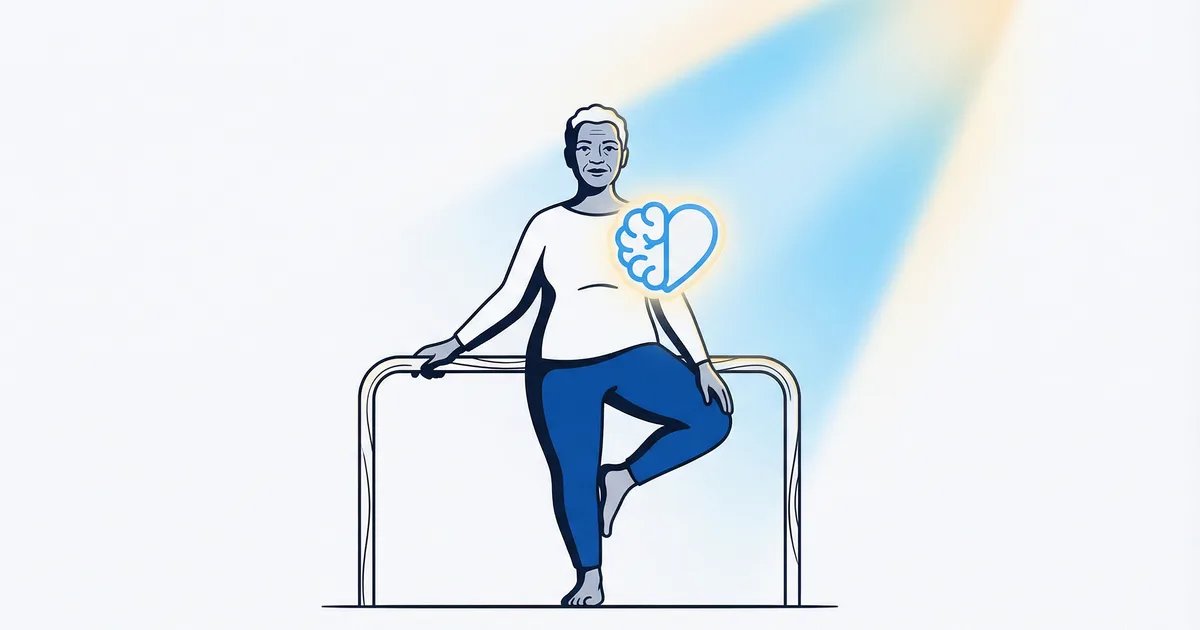
If you’ve ever noticed your mood feels a little better after you move—after a walk, a stretch, or a few minutes outside—you’re not imagining it.
What’s surprising is which kind of movement can help.
We usually think of mental health and exercise as “go for a run” or “hit the gym.” But for many older adults, that’s not realistic (or safe) every day.
The good news: research suggests gentler, balance-focused movement may support mood—and it can support thinking, too.12
In a 2025 randomized trial of adults 60+ receiving standard care for late-life depression, adding an exercise program (including a balance-focused option) was associated with an average 30% score reduction on a depression scale and a 29% increase in scores on a cognitive test.2
Important: This article is for education, not medical advice. If you’re being treated for depression, don’t stop or change medications without your clinician. If you’re feeling unsafe, dizzy, or at risk of falling, talk with a clinician or physical therapist before you self-train.
If you’re in immediate danger or thinking about self-harm, call 988 in the U.S. (Suicide & Crisis Lifeline) or your local emergency number.
Quick take (the “no hype” version)
- Balance training isn’t a replacement for mental health care. Think of it as a supportive tool you can add to your plan.
- Exercise helps depression in research, including gentle options like yoga, tai chi/qigong, and walking.1
- In a 2025 randomized trial of adults 60+ with late-life depression, adding aerobic, strength, or balance training to standard care improved depression and cognitive scores more than standard care alone.2
- The best “antidepressant exercise” is the one you’ll actually do—safely, consistently, and without making you dread it.
Try this today (2 minutes)
If you do nothing else, do this near a counter:
- Supported march (1 minute) — one hand on the counter
- Side steps (1 minute) — slow and controlled
Two minutes counts. Consistency beats intensity.
What we mean by “natural antidepressant” (and what we don’t)
The phrase “natural antidepressant” can sound like a promise.
That’s not what we’re doing here.
We’re using it as a plain-English shortcut for this idea:
Balance training can be a simple, body-based practice that supports mood—without needing intense workouts.
It’s not a replacement for professional care. It’s not a guarantee. It’s a tool you can add to your week—especially if you want something that also helps you feel steadier and more confident on your feet.
Why balance training can help mood (even though it looks “small”)
Balance work is often dismissed as “easy.” But your brain doesn’t treat it that way.
When you practice balance, you’re asking your nervous system to do a lot at once:
- Pay attention (to your feet, posture, and the space around you)
- Coordinate multiple muscles to keep you steady
- Integrate signals from vision, inner ear, and body sense (proprioception)
- Recover quickly from little wobbles
That combination matters because mood is not just “thoughts.” It’s also:
- energy and fatigue,
- stress physiology,
- confidence and safety,
- and how much you feel able to engage with life.
Balance training can support mood through a few real-world pathways:
1) It builds “I can do this” confidence
When you feel steady, you’re more likely to:
- leave the house,
- walk more,
- say yes to social plans,
- and do the activities that make life feel like your life.
Confidence isn’t fluff. For many people, it’s the bridge back to connection.
2) It’s gentle enough to do on low-energy days
If you’re feeling down, motivation can be the first thing to disappear.
Balance training lets you start small:
- 2 minutes at the counter,
- slow, supported steps,
- one simple “steady” drill at a time.
Small wins are how habits come back online.
3) It often includes calming, focus-based movement (like Tai Chi or yoga)
Many balance programs include movement styles that naturally pair:
- controlled breathing,
- slow weight shifts,
- and steady attention.
That’s not “woo.” It’s a practical way to lower the volume on stress.
What the research says (and how to read it safely)
1) The big-picture evidence: exercise and depression
A major 2024 review in The BMJ analyzed 218 randomized trials (over 14,000 participants) and found that exercise reduces depression symptoms compared with control conditions. Importantly, the evidence wasn’t limited to “hardcore” exercise—studies included things like strength training and mind-body movement (for example yoga and tai chi/qigong).1
This doesn’t mean “exercise cures depression.” It means exercise can be a legitimate part of a treatment package—especially when it’s realistic, tolerable, and safe.
2) A closer look for older adults: the 2025 trial
One of the most relevant studies for older adults was published in 2025 in Acta Psychologica.2
The setup (simple version)
Researchers studied 121 adults age 60+ with late-life depression. Everyone received standard care and continued antidepressant medication. Then people were assigned to 12 weeks of aerobic, strength, or balance training (either 3×/week or 5×/week), or to a control group (standard care without an exercise program).2
The study measured:
- HAMD‑17 (a standard depression scale), and
- MMSE (a common cognitive screening test).2
The results (what changed)
Across participants assigned to an exercise program (including the balance-training groups), the authors reported an average change of:
- Depression symptoms: HAMD‑17 decreased by 6.5 ± 2.8 points
- Cognitive score: MMSE increased by 5.7 ± 2.4 points2
What do those “points” actually mean?
Here’s a plain‑English way to read those numbers.
HAMD‑17 (depression symptoms)
- Scale range: 0–52 points (higher = more severe symptoms).3
- Baseline in this study: In the exercise groups, average baseline scores were about 21–22 points (Table 10).2
- What a 6.5‑point drop implies: From a baseline of ~21.5, a 6.5‑point decrease is roughly a 30% reduction from baseline (6.5 ÷ 21.5 ≈ 30%).2
- Clinical anchors used in the study: The paper defines remission as HAMD‑17 ≤ 7, and response as a ≥50% reduction from baseline.2
MMSE (thinking screen)
- Scale range: 0–30 points (higher = better).4
- Baseline and follow‑up in this study: The exercise group averaged 19.83 at baseline and 25.57 at follow‑up (Table 4) — about a +5.7 point gain.2
- What a 5.7‑point gain implies: That’s about a 29% increase from baseline (5.7 ÷ 19.83 ≈ 29%), and about 19% of the total possible MMSE points (5.7 ÷ 30).24
Two important caveats:
- These are group averages. Individual results vary.
- The MMSE is a brief screening test. Scores can shift with repeat testing (“practice effects”), sleep, stress, and mood — and depression itself can affect thinking. So this is not the same thing as “reversing dementia.”
How does that compare to medications? (Useful, but not 1:1)
These comparisons are only to help you feel the size of a change on the same kind of scales — not to guide medication decisions.
- Fluoxetine (Prozac) for depression: In one analysis of FDA antidepressant trials (including fluoxetine), the average medication–placebo difference on the Hamilton depression scale was about 1.8 points.5 That’s a between‑group difference — not the same as a before‑and‑after change within one group.
- Donepezil (Aricept) for Alzheimer’s symptoms: A Cochrane review found donepezil improved MMSE by ~1.05 points vs placebo at ~26 weeks on average.6 Different condition, different timeframe — but it gives a point‑scale reference.
- Memantine (Namenda) for moderate–severe Alzheimer’s symptoms: A Cochrane review reported a small cognitive benefit vs placebo on the Severe Impairment Battery (SIB, 0–100) of about 3.11 points.7 (Not directly comparable to MMSE — just another “point scale” reference.)
The authors report these improvements were significantly greater than those observed in the control group.2
“…improvements were significantly greater than those observed in the control group.”2
The biggest improvements in that trial came from high-frequency aerobic exercise (5×/week).2 But balance training was still part of the “exercise works” story—and it has a major practical advantage:
Balance-focused movement can be one of the most realistic on-ramps—especially when you’re tired, sore, anxious, or afraid of falling.
What this does not mean
This study does not say:
- “Balance training replaces therapy or medication.”
- “Balance training cures depression.”
- “Everyone will improve the same way.”
What it does support is a hopeful, practical takeaway:
Adding balance-focused movement can be a meaningful part of a whole-person plan—especially for older adults.
What counts as “balance training” (in real life)
Balance training doesn’t have to be fancy. It’s any practice that safely challenges steadiness, coordination, and control—especially in the legs and hips.
Examples (pick what feels doable):
- supported one‑leg stands (fingertips on the counter),
- heel‑to‑toe walking along a counter,
- slow marching with posture,
- side steps and gentle turns,
- simple tai chi or yoga sequences,
- stepping over an imaginary line (or a piece of tape),
- sit‑to‑stand practice (strength + balance).
If you’ve had recent falls or you feel unsafe, a physical therapist can help you choose options that match your body and your home setup.
A simple, safety-first starter plan (10 minutes, 3 days/week)
If you want to try balance training as a mood-support habit, keep it:
- safe (support nearby),
- short (so you’ll do it),
- and repeatable (so you can build momentum).
Step 1: Set up your “safety rail”
- Stand near a kitchen counter or sturdy table.
- Wear stable shoes (not socks on slick floors).
- Make sure the room is well lit.
- Clear rugs, cords, and clutter.
If anything feels unsafe: stop. Your plan should feel “challenging but doable,” not scary.
Step 2: Do this 10-minute routine (3 days/week)
0:00–1:00 — “arrive”
- One hand on the counter.
- 3 slow breaths.
- Soften your knees. Relax your shoulders.
1:00–3:00 — march (supported)
- March in place with a light hand on the counter.
- Go slow. Try to stand tall.
3:00–5:00 — side steps
- Step right, then left.
- Keep your feet pointed forward and your steps controlled.
5:00–7:00 — heel-to-toe walk
- Along the counter, walk heel-to-toe (like a tightrope, but slow).
- If you wobble, that’s normal. Use your hand.
7:00–9:00 — supported one-leg stands
- 20–30 seconds per side.
- Fingertips on the counter is enough.
9:00–10:00 — sit-to-stand
- From a sturdy chair, stand up and sit down slowly (hands on the chair if needed).
- Control the “sit” part.
If standing feels like too much today (seated option)
Low-energy days still count. Try 5 minutes seated:
- Seated marching (1 minute) — tall posture, gentle pace
- Seated heel/toe raises (1 minute) — slow and controlled
- Seated “weight shift” (1 minute) — shift weight side-to-side in the chair
- Seated sit-to-stand practice (2 minutes) — only if safe today (use armrests, go slow)
Step 3: Make it a 12-week experiment
That 2025 study ran for 12 weeks.2
You don’t need perfection. You need reps.
Try this simple goal:
- 3 days/week for 12 weeks, plus
- a 2-minute “steady snack” on off days (even just marching at the counter).
When to ask for extra support (physical or emotional)
Please don’t white-knuckle this alone if you’re struggling.
Consider reaching out if you have:
- persistent low mood or loss of interest,
- big changes in sleep or appetite,
- thoughts of hopelessness,
- or anything that makes daily life feel unmanageable.
For balance training specifically, it’s smart to ask a clinician or PT for guidance if you’ve had recent falls, new dizziness, numbness/tingling, or sudden walking changes.
Make it measurable (and more motivating)
Mood improves with consistency—but it’s easier to stay consistent when you can see progress.
Once a week, jot down three numbers (0–10):
- Mood: “How’s my mood been overall?”
- Energy: “How much get-up-and-go do I have?”
- Steadiness confidence: “How confident do I feel walking around the house / outside?”
You’re looking for a trend, not a perfect day.
Pick one simple baseline (like seconds on one leg) and track it weekly—progress is the goal, not perfection.