

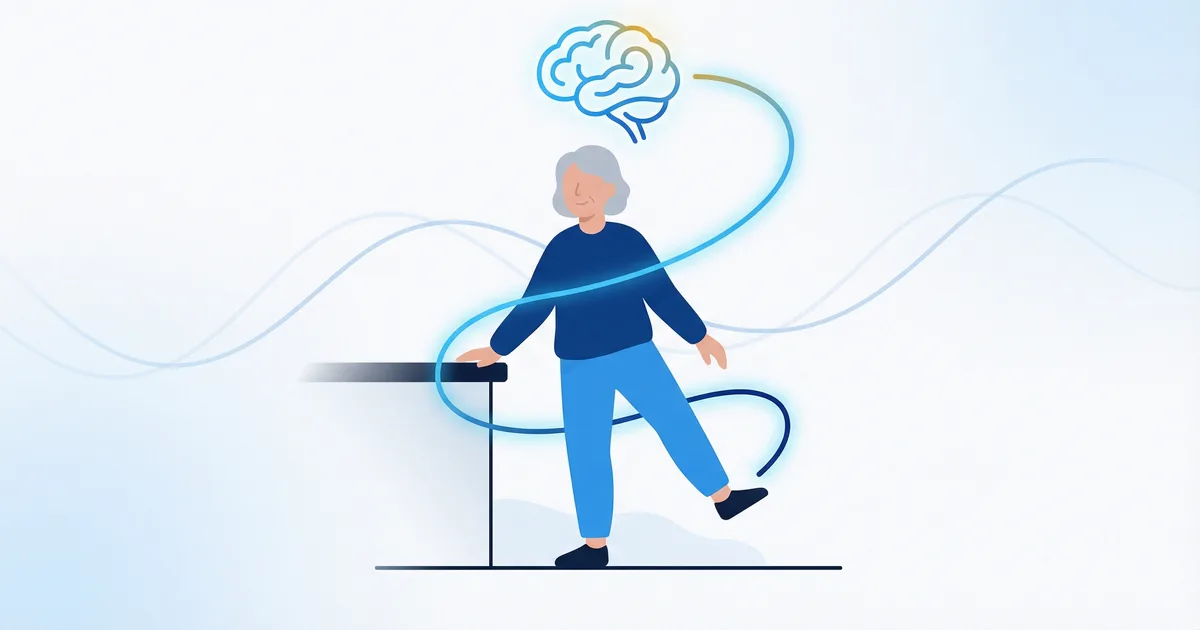
Balance training looks like a “legs and feet” skill.
But every time you practice balance, your brain is working hard too:
- It gathers signals (eyes, inner ear, body sense).
- It predicts what will happen next.
- It makes tiny corrections—fast.
That’s why balance practice often feels mentally tiring in a way that a slow walk doesn’t.
Important: This article is for education, not medical advice. If you’ve had recent falls, new dizziness, fainting, new weakness/numbness, or sudden changes in walking or memory, talk with a clinician first. For any balance drill, use a stable support (like a kitchen counter) and stop if you feel unsafe.
Quick Take: What balance training can do for your brain
- Balance is “brain training in disguise.” It challenges attention, coordination, and reaction time.
- Walking and thinking are connected. Research on aging and dementia highlights that gait and balance changes can show up alongside cognitive change.1
- Balance-focused exercise may support cognition. In a 2025 randomized trial in older adults, balance-based training (including Tai Chi, yoga, and balance-pad drills) was linked with improvements in mood and cognitive test scores.2
- Combining balance + simple thinking tasks may help even more. Studies on “dual-task” training (moving while thinking) have found improvements in both motor skills and cognitive performance measures.3
- Safety comes first. If adding a “brain task” makes you wobble, the task is too hard for right now. Use support, simplify, or do the thinking task seated.
Why balance is brain work (not just “standing still”)
Your brain’s job in balance is not to make you perfectly still.
It’s to keep you upright while real life happens:
- turning your head to talk,
- carrying something,
- stepping off a curb,
- walking on carpet, grass, or gravel,
- reacting to a dog toy in the hallway.
To do that, your brain runs a constant loop:
- Sense: Where am I? Where is my weight?
- Predict: If I keep moving like this, will I stay stable?
- Correct: Tiny muscle adjustments (and sometimes a recovery step).
That loop uses brain systems involved in:
- attention (staying on the task),
- processing speed (responding quickly),
- planning and “switching” (adjusting when the plan changes),
- and spatial awareness (where you are in space).
This is one reason many people feel unsteady when they’re distracted. You’re not “weak.” Your brain is juggling more.
The brain‑balance connection: what the research suggests (without over‑promising)
Let’s keep the science honest:
- Some studies show associations (two things move together).
- Some studies test interventions (training that changes outcomes).
- None of this is a guarantee, and none of it diagnoses dementia.
But the big picture is clear:
Balance and cognition aren’t separate lanes. They share the road.
Here are a few research areas worth knowing about.
1) Gait and cognition often change together
An analysis in JAMA Network Open highlights a growing body of work linking gait (how we walk) with cognitive change in aging and dementia.1
In plain language:
- If walking becomes slower, less steady, or more “effortful,” it can be a sign that multiple systems (including brain systems) are under more strain.
- That does not mean “unsteady = dementia.”
- It does mean balance and walking are worth paying attention to—early and safely.
2) Balance-focused training has been linked with cognitive test improvements
In a 2025 randomized controlled trial of adults age 60+ with late-life depression, researchers compared different exercise styles added to usual care. The balance-focused program included simplified Tai Chi, basic yoga, and balance-pad training.2
Alongside mood improvements, the balance groups also improved on a common cognitive screening test (MMSE).2
Two important “real life” takeaways:
- The program was structured (weeks, not days).
- The exercises were gentle-but-skilled (not max-intensity workouts).
If you want a mood-focused walkthrough of this same study (with a simple starter plan), see: Balance Training as a Natural Antidepressant.
3) Combining “body + brain” training can be especially effective
If your goal is brain health, one of the most practical ideas is also the simplest:
Don’t make it body or brain. Make it both.
A 2024 randomized trial in older adults with mild cognitive impairment found that a combined physical–cognitive program improved functional and cognitive measures compared with cognitive training alone.4
This doesn’t mean everyone needs formal “brain games.” It supports a general principle:
- Move in ways that require focus and coordination, not just repetition.
- Add a small cognitive challenge when it’s safe (more below).
4) Dual-task training: “moving while thinking”
Dual-task training is exactly what it sounds like: you practice movement while your brain does a simple second job.
Examples:
- walking while naming animals,
- stepping side-to-side while counting,
- balancing near a counter while doing an easy word game.
In a 2023 randomized trial in cognitively normal older women, a 12-week dual-task physical–cognitive program improved balance, gait, strength, and measures of verbal fluency (a thinking skill related to language and executive function).3
The practical point isn’t the specific test. It’s the idea that the “brain load” is trainable, just like the physical load.
A safety-first “brain-friendly” balance routine (8 minutes)
If you want the cognitive benefits of balance training, you don’t need anything fancy.
You need two things:
- A safe setup
- A repeatable habit
Step 1: Set up your safety rail
- Stand near a kitchen counter or sturdy table.
- Wear stable shoes (not socks on slick floors).
- Clear rugs, cords, and clutter.
- Use good lighting.
If you feel unsafe at any point: stop. “Safe and repeatable” beats “brave.”
Step 2: Do this 8-minute routine (3 days/week)
Do one round. Rest as needed.
0:00–1:00 — Arrive
- One light hand on the counter.
- 3 slow breaths.
- Stand tall, knees soft, shoulders relaxed.
1:00–2:00 — March (supported)
- Slow marching in place, light hand support.
- Optional brain add‑on: name 5–10 animals (easy pace).
2:00–3:00 — Side steps
- Step right, then left.
- Keep steps controlled and your chest tall.
- Brain add‑on: count up by 1s (or just breathe slowly).
3:00–4:00 — Heel‑to‑toe walk (along the counter)
- Walk heel-to-toe, slow.
- If that’s too hard, just walk normally but slowly and smoothly.
4:00–6:00 — Supported one‑leg stands
- 20–30 seconds per side (or shorter if needed).
- Brain add‑on: say the months of the year in order.
6:00–8:00 — Sit‑to‑stand
- From a sturdy chair, stand up and sit down slowly.
- Use hands as needed. Control the “sit” part.
The “brain rule” (important)
If a brain add‑on makes you wobble, you have three safe options:
- Hold the counter more
- Make the brain task easier
- Do the brain task seated
You’re not failing. You’re finding the right challenge level for today.
Make it measurable (and more motivating)
Cognitive benefits are hard to “see” day to day.
Balance progress is easier to track—and confidence grows when you can see a trend.
Pick one simple baseline (like seconds on one leg) and track it weekly—trends beat one-day scores.
When to get extra help
Balance training is a great self-care habit. It’s also okay to ask for support.
Consider talking with a clinician (or a physical therapist) if you notice:
- repeated falls or near-falls,
- new dizziness or fainting,
- new numbness/tingling in the feet,
- a sudden change in walking,
- or memory/thinking changes that worry you.
The best plan is the one that keeps you safe—and helps you keep living your life.