


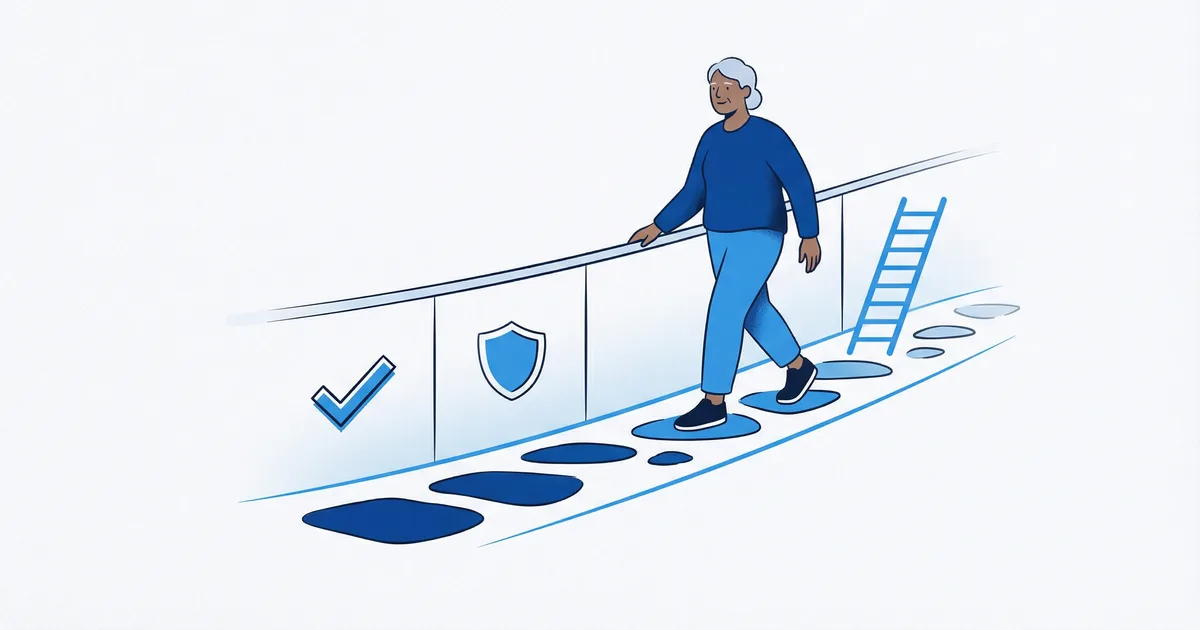
Everything you need to know to master balance training, regain confidence, and maintain your independence—all from the comfort of your own home.
⸻
Table of Contents
- Before You Begin: Essential Safety Guidelines & Self-Assessment
- Your Balance Training Foundation: Preparation & Warm-Ups
- Core Balance Exercises: Your Complete Exercise Library
- Progressive Training Programs: 4-Week Plans for Every Level
- Advanced Techniques: Challenge Yourself Safely
- Sneaky Ways to Work Balance Into Everyday Life
- Troubleshooting: Common Challenges & Solutions
- Safety First: When to Seek Professional Help
- Equipment Guide: What You Need (Spoiler: Not Much!)
- Frequently Asked Questions
- Your Next Steps: Building Long-Term Success
⸻
Welcome to your journey toward better balance, greater confidence, and lasting independence. If you've ever felt unsteady on your feet, worried about falling, or simply want to maintain your mobility as you age, you're in exactly the right place.
This isn't just another collection of exercises—it's your comprehensive roadmap to mastering balance training in a way that's safe, effective, and surprisingly enjoyable. Whether you're a complete beginner or someone looking to refine your existing routine, this guide will meet you where you are and help you progress at your own pace.
What makes this guide different?
We've distilled decades of research and real-world experience into practical, actionable strategies that work for real people in real homes. No gym membership required. No expensive equipment needed. Just you, a comfortable space, and the commitment to invest in your long-term health and independence.
⸻
Before You Begin: Essential Safety Guidelines & Self-Assessment
Before we dive into the exciting world of balance training, let's establish a foundation of safety and understanding. Think of this as your pre-flight checklist—essential steps that ensure your journey is both safe and successful.
Your Quick Balance Assessment
Before you begin any training program, it's crucial to understand your current balance abilities. These simple tests will help you establish your baseline and track your progress over time.
Test 1: Single-Leg Stand
- Stand next to a sturdy chair or wall for safety
- Lift one foot off the ground, keeping it close to your standing leg
- Keep your eyes open and focused on a point in front of you
- Time how long you can hold this position
- Repeat with the other leg
What to look for: Can you hold this position for at least 10 seconds on each leg? If not, don't worry—this is exactly why we're here.
Test 2: Tandem Walk
- Find a straight line on the floor (or imagine one)
- Place one foot directly in front of the other, heel to toe
- Take 10 steps forward, maintaining this heel-to-toe pattern
- Keep your arms out for balance if needed
What to look for: Can you complete 10 steps without stepping off your imaginary line more than twice?
Test 3: Sit-to-Stand
- Sit in a sturdy chair with your arms crossed over your chest
- Stand up without using your hands or arms for support
- Sit back down in a controlled manner
- Repeat this sequence
What to look for: Can you complete this movement smoothly and without wobbling?
Essential Safety Guidelines
The Golden Rules of Balance Training:
-
Always have support nearby. Keep a sturdy chair, wall, or counter within arm's reach during all exercises.
-
Clear your space. Remove throw rugs, ensure good lighting, and create a clutter-free zone around your exercise area.
-
Start slow, progress gradually. Better to master the basics than to rush into advanced movements.
-
Listen to your body. Mild challenge is good; pain, dizziness, or extreme fatigue are signals to stop.
-
Consistency trumps intensity. Five minutes of daily practice beats an hour once a week.
When to Exercise Caution
Pause and consult your healthcare provider if you experience:
- Dizziness or vertigo
- Sharp pain in joints or muscles
- Shortness of breath during light activity
- Numbness or tingling in your feet
- Recent falls or near-falls
Medication Check: If you take medications for blood pressure, diabetes, or anxiety, discuss your balance training plans with your doctor. Some medications can affect balance, and timing your exercise around medication schedules may be beneficial.
⸻
Your Balance Training Foundation: Preparation & Warm-Ups
Just as a house needs a solid foundation, your balance training needs proper preparation. These foundational exercises will prepare your body for more challenging balance work while providing immediate benefits for your daily activities.
The 5-Minute Daily Warm-Up Routine
Do this routine before any balance training session—and ideally every morning to start your day strong.
1. Ankle Circles (1 minute)
- Sit comfortably or stand with one hand on a chair
- Lift one foot slightly off the ground
- Slowly circle your ankle 10 times clockwise, then 10 times counterclockwise
- Switch feet and repeat
- Why it matters: Your ankles are your first line of defense against losing balance. Keeping them mobile and strong is crucial.
2. Marching in Place (1 minute)
- Stand tall with your feet hip-width apart
- Lift one knee toward your chest, then lower it
- Alternate legs as if marching in place
- Keep your core engaged and your posture upright
- Focus on: Lifting your knees to waist level if possible, but work within your comfortable range.
3. Heel-to-Toe Shifts (1 minute)
- Stand with your feet together
- Slowly shift your weight forward onto your toes
- Hold for 2 seconds, then shift back onto your heels
- Keep your movements slow and controlled
- Pro tip: Imagine you're a tree gently swaying in the breeze.
4. Hip Circles (1 minute)
- Stand with your hands on your hips
- Make small circles with your hips, 5 times in each direction
- Keep your knees slightly bent and your core engaged
- Benefits: Improves hip mobility and activates your core stabilizing muscles.
5. Gentle Neck Turns (1 minute)
- Stand or sit comfortably
- Slowly turn your head to the right, hold for 2 seconds
- Return to center, then turn to the left
- Repeat 5 times in each direction
- Important: This helps activate your vestibular system, which plays a crucial role in balance.
Strength Foundations for Better Balance
These exercises build the fundamental strength needed for all balance activities. Include them in your routine 3-4 times per week.
Wall Push-Ups (10-15 repetitions)
- Stand arm's length from a wall
- Place your palms flat against the wall at shoulder height
- Lean forward, then push back to starting position
- Benefits: Builds upper body and core strength essential for balance recovery.
Chair-Assisted Squats (10-15 repetitions)
- Stand in front of a sturdy chair
- Lower yourself as if sitting down, but stop just before touching the chair
- Stand back up to full height
- Focus on: Keeping your knees over your toes and your chest up.
Calf Raises (15-20 repetitions)
- Stand behind a chair, holding the back for support
- Rise up onto your toes, lifting your heels off the ground
- Lower back down slowly and with control
- Variation: Once this becomes easy, try doing it on one foot at a time.
Standing Side Leg Lifts (10 per leg)
- Stand behind a chair for support
- Lift one leg out to the side, keeping your toes pointing forward
- Lower with control
- Key point: Keep your torso upright—avoid leaning away from the lifted leg.
⸻
Core Balance Exercises: Your Complete Exercise Library
Welcome to the heart of your balance training program. These exercises are carefully organized by difficulty level, allowing you to progress safely and confidently. Remember: mastery of the basics is far more valuable than rushing to advanced movements.
Level 1: Building Your Foundation (Weeks 1-2)
These exercises focus on static balance—holding steady positions while building confidence.
Exercise 1: Supported Single-Leg Stand
Equipment needed: Sturdy chair or wall Duration: Start with 10 seconds, work up to 30 seconds per leg
How to do it:
- Stand next to a chair or wall, lightly touching it with your fingertips
- Lift one foot off the ground, keeping it close to your standing leg
- Focus on a fixed point in front of you
- Breathe normally and try to stay as still as possible
- Switch legs and repeat
Progression tips:
- Week 1: Use full hand support on the chair
- Week 2: Use only fingertip support
- When ready: Try without any support for short periods
Common mistakes to avoid:
- Gripping the chair too tightly (you should be able to lift your hand easily)
- Holding your breath
- Looking down at your feet
Exercise 2: Heel-to-Toe Standing
Equipment needed: Wall for support Duration: Hold for 10-30 seconds
How to do it:
- Stand with one foot directly in front of the other, heel touching toe
- Keep your hands on a wall for support if needed
- Focus on maintaining this narrow stance
- Switch which foot is in front and repeat
What you're training: This exercise challenges your lateral (side-to-side) stability, which is crucial for walking and navigating tight spaces.
Exercise 3: Weight Shifting
Equipment needed: None Duration: 10 shifts in each direction
How to do it:
- Stand with your feet hip-width apart
- Slowly shift your weight to your right foot, lifting your left heel slightly
- Hold for 2 seconds, then shift to your left foot
- Next, shift forward onto your toes, then back onto your heels
- Keep movements slow and controlled
Focus on: Feeling the weight transfer through your feet and maintaining control throughout the movement.
Level 2: Dynamic Movements (Weeks 3-4)
Now we add movement to your balance training, simulating real-life activities.
Exercise 4: Supported Tandem Walking
Equipment needed: Wall or hallway Distance: Start with 10 steps, work up to 20
How to do it:
- Stand at one end of a hallway or next to a wall
- Place one foot directly in front of the other, heel to toe
- Take a step forward, again placing heel to toe
- Continue for your target number of steps
- Use the wall for support as needed
Real-world application: This exercise directly improves your ability to walk in narrow spaces and navigate crowded areas.
Exercise 5: Standing Marching
Equipment needed: Chair for support Duration: 30 seconds to 1 minute
How to do it:
- Stand behind a chair, holding it lightly for support
- Lift one knee up toward your chest
- Lower it down and immediately lift the other knee
- Continue alternating legs as if marching in place
- Maintain good posture throughout
Challenge variation: Once comfortable, try lifting your hands off the chair for a few seconds at a time.
Exercise 6: Clock Reaches
Equipment needed: Chair or wall for support Repetitions: 5 reaches to each "hour" on each leg
How to do it:
- Stand on one leg next to your support
- Imagine you're standing in the center of a large clock
- With your free leg, reach out to touch "12 o'clock" (straight ahead)
- Return to center, then reach to "3 o'clock" (to the side)
- Continue to "6 o'clock" (behind you) and "9 o'clock" (other side)
- Switch standing legs and repeat
Why it's effective: This exercise challenges your balance in all directions while improving hip flexibility and strength.
Level 3: Challenge Yourself (Weeks 5-8)
These exercises add complexity and challenge to keep your balance system adapting.
Exercise 7: Eyes-Closed Balance
Equipment needed: Chair or wall nearby for safety Duration: Start with 5 seconds, work up to 30 seconds
How to do it:
- Start with any of the previous exercises you've mastered
- Close your eyes while maintaining the position
- Focus on the sensations in your feet and legs
- Keep your support within easy reach
Important safety note: Always have someone nearby or ensure you're in a safe space when doing eyes-closed exercises.
Exercise 8: Unstable Surface Training
Equipment needed: Folded towel or pillow Duration: 30 seconds to 1 minute
How to do it:
- Place a folded towel or firm pillow on the ground
- Step onto it with both feet
- Practice your basic balance exercises on this unstable surface
- Start with double-leg stands before progressing to single-leg
What's happening: The unstable surface forces your stabilizing muscles to work harder, improving your balance reactions.
Exercise 9: Functional Movements
Equipment needed: Various household items Duration: 2-3 minutes
Activities to try:
- Stand on one leg while brushing your teeth
- Practice heel-to-toe walking while carrying a light object
- Stand from a chair without using your hands
- Walk backward for 10 steps (with support nearby)
The goal: Integrate balance challenges into activities you already do daily.
Creating Your Personal Exercise Routine
Here's how to combine these exercises into an effective routine:
Beginner Routine (10 minutes):
- 5-minute warm-up
- 3 Level 1 exercises (30 seconds each, 2 sets)
- Cool-down stretches
Intermediate Routine (15 minutes):
- 5-minute warm-up
- 2 Level 1 exercises (30 seconds each)
- 3 Level 2 exercises (45 seconds each, 2 sets)
- Cool-down stretches
Advanced Routine (20 minutes):
- 5-minute warm-up
- 1 Level 1 exercise (for confidence)
- 2 Level 2 exercises (1 minute each)
- 3 Level 3 exercises (45 seconds each, 2 sets)
- Cool-down stretches
⸻
Progressive Training Programs: 4-Week Plans for Every Level
Success in balance training comes from consistent, progressive practice. These structured programs take the guesswork out of your training while ensuring you're always challenged appropriately.
Program 1: The Confident Beginner (Weeks 1-4)
Perfect for: Those new to balance training or returning after a long break.
Week 1: Building Awareness Goal: Establish routine and basic stability Frequency: Daily, 10 minutes
Daily Routine:
- 5-minute warm-up
- Supported Single-Leg Stand: 10 seconds per leg, 3 sets
- Heel-to-Toe Standing: Hold 10 seconds, 3 sets
- Weight Shifting: 10 shifts each direction
- Cool-down: Gentle stretching
Week 1 Focus: Master the feeling of being on one leg and understand your balance limits.
Week 2: Increasing Duration Goal: Build endurance in static positions Frequency: Daily, 12 minutes
Daily Routine:
- 5-minute warm-up
- Supported Single-Leg Stand: 15 seconds per leg, 3 sets
- Heel-to-Toe Standing: Hold 15 seconds, 3 sets
- Weight Shifting: 15 shifts each direction
- Standing Marching: 30 seconds
- Cool-down: Gentle stretching
Week 2 Focus: Increase your holding times and add the first dynamic movement.
Week 3: Adding Movement Goal: Introduce dynamic balance challenges Frequency: Daily, 15 minutes
Daily Routine:
- 5-minute warm-up
- Supported Single-Leg Stand: 20 seconds per leg, 2 sets
- Supported Tandem Walking: 10 steps forward and back
- Standing Marching: 45 seconds
- Clock Reaches: 3 positions per leg
- Cool-down: Gentle stretching
Week 3 Focus: Combine static and dynamic exercises for comprehensive training.
Week 4: Building Confidence Goal: Reduce support and increase complexity Frequency: Daily, 15 minutes
Daily Routine:
- 5-minute warm-up
- Less-Supported Single-Leg Stand: 20 seconds per leg, 2 sets
- Tandem Walking: 15 steps with minimal support
- Standing Marching: 1 minute
- Clock Reaches: 4 positions per leg
- Cool-down: Gentle stretching
Week 4 Focus: Begin reducing your reliance on support while maintaining safety.
Program 2: The Steady Improver (Weeks 5-8)
Perfect for: Those who've completed the beginner program or have some balance training experience.
Week 5: Reducing Support Goal: Increase independence from support Frequency: Daily, 18 minutes
Week 6: Eyes-Closed Challenges Goal: Challenge your proprioceptive system Frequency: Daily, 20 minutes
Week 7: Unstable Surfaces Goal: Introduce reactive balance training Frequency: Daily, 20 minutes
Week 8: Integration and Assessment Goal: Combine skills and measure progress Frequency: Daily, 22 minutes
Program 3: The Balance Master (Weeks 9-12)
Perfect for: Those ready for advanced challenges and functional integration.
Detailed programs for Weeks 5-12 continue with specific exercises, progressions, and safety modifications...
⸻
Sneaky Ways to Work Balance Into Everyday Life
The secret to long-term balance improvement isn't just formal exercise sessions—it's weaving balance challenges into the activities you already do every day. Here are creative ways to turn routine moments into balance training opportunities.
In the Kitchen: Culinary Balance
Morning Coffee Ritual
- Stand on one leg while waiting for your coffee to brew
- Progress from 30 seconds to the full brewing time
- Switch legs halfway through for balanced training
Cooking Prep Magic
- Practice weight shifts while chopping vegetables
- Stand in tandem position while stirring soups or sauces
- Do calf raises while waiting for water to boil
Dishwashing Balance
- Stand on one leg while scrubbing dishes
- Practice heel-to-toe stance while loading the dishwasher
- Do gentle side steps while wiping down counters
Bathroom Balance Breaks
The Toothbrush Challenge
- Stand on one leg for the full 2 minutes of brushing
- Switch legs at the 1-minute mark
- Progress to closing your eyes for the last 30 seconds
Getting Ready Routines
- Practice tandem stance while applying makeup or shaving
- Do weight shifts while blow-drying your hair
- Stand on one leg while putting on shoes (this one's practical too!)
Entertainment Balance
TV Time Training
- Do balance exercises during commercial breaks
- Practice side leg lifts while watching the news
- Stand during entire shows (start with 15-minute episodes)
Phone Call Fitness
- Walk heel-to-toe while on phone calls
- Practice single-leg stands during long conversations
- Do gentle marching in place while listening
The "Balance Habit Stack" Method
Link balance training to existing habits:
- After I pour my morning coffee → I practice single-leg stands
- After I brush my teeth → I do heel-to-toe walking
- After I check my email → I do 10 weight shifts
- After I put on my pajamas → I practice clock reaches
Making It Social and Fun
Family Challenges
- Create balance challenges for grandchildren to do with you
- Have balance competitions during family gatherings
- Teach others your favorite "sneaky" balance tricks
The key principle: Balance training doesn't have to be separate from your life—it can be woven into the fabric of your daily activities, making it sustainable and enjoyable.
⸻
Advanced Techniques: Challenge Yourself Safely
Once you've mastered the fundamentals, these advanced techniques will keep your balance system sharp and responsive. Remember: advanced doesn't mean unsafe—it means more challenging within appropriate limits.
Multi-Tasking Balance Challenges
The Cognitive Challenge Balance isn't just physical—your brain plays a crucial role. These exercises challenge both your balance and your thinking:
Exercise: Count Backwards
- Perform your favorite balance exercise
- Count backwards from 100 by 7s (100, 93, 86, 79...)
- This forces your brain to divide attention between balance and thinking
Exercise: Word Games
- Stand on one leg while naming animals A-Z
- Or recite your grocery list while doing tandem walking
- Start with familiar lists before trying new challenges
Environmental Challenges
Exercise: Light Variations
- Practice your exercises in different lighting conditions
- Try dim lighting (safely, with support nearby)
- This helps your balance system rely less on vision
Exercise: Surface Variations
- Practice on carpet, hardwood, grass (outdoors with supervision)
- Each surface provides different feedback to your feet
- Start with familiar exercises before trying new surfaces
Balance Integration Activities
Functional Movement Sequences
- Combine multiple exercises into flowing sequences
- Example: Tandem walk → Single leg stand → Clock reach → Weight shift
- This mimics the complex balance demands of real life
Advanced Program Sample (For experienced practitioners)
Daily Advanced Routine (25 minutes):
- Dynamic warm-up (7 minutes)
- Multi-tasking balance holds (5 minutes)
- Surface variation exercises (5 minutes)
- Functional movement sequences (5 minutes)
- Cool-down and reflection (3 minutes)
⸻
Troubleshooting: Common Challenges & Solutions
Every balance training journey comes with obstacles. Here are the most common challenges our users face and proven strategies to overcome them.
Challenge 1: "I Get Dizzy During Exercises"
Possible causes:
- Moving too quickly between positions
- Holding your breath
- Dehydration
- Medication effects
Solutions:
- Slow down all movements by 50%
- Focus on breathing normally throughout exercises
- Ensure you're well-hydrated before exercising
- Practice shorter sessions (5 minutes instead of 15)
- Consult your doctor about medication timing
When to seek help: If dizziness persists or worsens, consult your healthcare provider.
Challenge 2: "I Can't Hold Single-Leg Stands for More Than 2 Seconds"
Remember: Everyone starts somewhere! Here's how to progress:
Week 1-2: Build the foundation
- Use full hand support on a chair
- Hold for your maximum time (even if it's 1 second)
- Practice 5 times per day
- Focus on finding your balance point
Week 3-4: Reduce support gradually
- Use fingertip support
- Increase holding time by 1 second each day
- Practice next to a wall for confidence
Week 5+: Challenge yourself
- Try brief moments without support
- Celebrate every improvement, no matter how small
Challenge 3: "I Don't Have Time for Daily Practice"
Reality check: You need less time than you think!
Micro-sessions (1 minute each):
- Single-leg stands while coffee brews
- Weight shifts while on phone calls
- Heel-to-toe walking during TV commercials
The "Habit Stack" approach:
- Attach 30-second balance exercises to existing habits
- Morning routine + balance = automatic practice
- Quality over quantity always wins
Challenge 4: "I'm Afraid of Falling"
This is completely normal and shows good judgment!
Building confidence safely:
- Always practice near sturdy support
- Start with both feet on ground exercises
- Use thick carpet or yoga mat for cushioning
- Practice when others are nearby
- Remember: the goal is challenge, not danger
Gradual exposure:
- Week 1: Full support, eyes open
- Week 2: Light support, eyes open
- Week 3: Fingertip support, eyes open
- Week 4: Brief moments of no support
Challenge 5: "I Don't See Progress"
Hidden progress you might be missing:
- Increased confidence in daily activities
- Less wobbling during exercises (even if time hasn't increased)
- Improved posture throughout the day
- Better sleep (common side effect of balance training)
- Reduced anxiety about walking
Measuring progress effectively:
- Keep a simple log of exercise duration
- Record how you feel during daily activities
- Note improvements in other exercises
- Ask family members if they notice changes
Challenge 6: "My Arthritis Makes It Painful"
Adaptations for joint pain:
- Choose low-impact exercises (weight shifts, seated exercises)
- Practice after taking pain medication (if applicable)
- Use warm-up routines to reduce stiffness
- Focus on pain-free range of motion
- Consider pool-based balance exercises
Remember: Some muscle fatigue is normal; joint pain is not.
Challenge 7: "I Keep Forgetting to Practice"
Memory aids that work:
- Set phone alarms for exercise times
- Put sticky notes in obvious places
- Use a visible calendar to track practice
- Ask family members to remind you
- Link practice to existing habits
Visual reminders:
- Keep exercise instructions visible
- Use a large calendar to mark completed sessions
- Create a simple checklist
⸻
Safety First: When to Seek Professional Help
Your safety is our highest priority. While balance training is generally safe for most people, certain situations require professional guidance. Here's your comprehensive guide to recognizing when you need additional support.
Red Flags: Don't train if having these
- Dizziness / vertigo
- Chest pain or shortness of breath during light activity
- Severe joint pain that doesn't improve with rest
- Numbness or tingling in your feet or legs causing balance issues
- Double vision
When to Consult Your Healthcare Provider
Before starting any balance program:
- You can't walk independently or with a cane (ex: walker-dependent)
- If you've had more than one fall in the past 6 months
- If you have diabetes with neuropathy (nerve damage)
- If you have vision problems that aren't corrected with glasses
- History of fainting or low blood pressure
During your training:
- If exercises consistently cause pain (not just muscle fatigue)
- If you experience persistent dizziness
- If you notice declining rather than improving balance
- If you have concerns about your progress
Types of Professionals Who Can Help
Physical Therapist
- Specializes in movement and balance training
- Can assess your specific balance challenges
- Creates personalized exercise programs
- Provides hands-on guidance and safety
Occupational Therapist
- Focuses on daily living activities
- Can evaluate your home for fall risks
- Helps adapt activities to your abilities
- Provides equipment recommendations
Audiologist
- Evaluates inner ear (vestibular) problems
- Can diagnose balance-related hearing issues
- Provides specialized vestibular rehabilitation
Ophthalmologist/Optometrist
- Evaluates vision-related balance problems
- Ensures proper prescription for glasses/contacts
- Identifies eye conditions affecting balance
Questions to Ask Your Healthcare Provider
Before starting balance training:
- "Are there any exercises I should avoid?"
- "How do my medications affect my balance?"
- "What symptoms should I watch for during exercise?"
- "How often should we reassess my balance?"
If you're experiencing problems:
- "Could my symptoms indicate a serious condition?"
- "Would physical therapy be beneficial for me?"
- "Should we review my medications?"
- "Are there tests that could help identify the cause?"
Working With Healthcare Professionals
Maximize your appointments:
- Keep a log of your balance challenges
- Bring a list of your medications
- Write down your questions beforehand
- Bring a family member if helpful
Be honest about:
- Any falls or near-falls
- Fears or anxieties about balance
- Pain levels during activities
- How balance problems affect your daily life
Home Safety Assessment
A professional can help evaluate:
- Lighting throughout your home
- Stair safety and handrails
- Bathroom safety equipment
- Floor surfaces and rugs
- Furniture placement for safe navigation
Insurance and Cost Considerations
Many insurance plans cover:
- Physical therapy for balance problems
- Occupational therapy evaluations
- Medical evaluations for dizziness
- Some home safety assessments
Questions to ask your insurance:
- "What balance-related services are covered?"
- "Do I need a referral from my primary doctor?"
- "How many therapy sessions are covered per year?"
⸻
Equipment Guide: What You Need (Spoiler: Not Much!)
One of the beautiful aspects of balance training is its simplicity. You don't need expensive equipment or a gym membership—most effective balance exercises can be done with items you already have at home.
Essential Equipment (Free to $20)
Your Most Important "Equipment": A Sturdy Chair
- Any stable chair with a back works perfectly
- Kitchen chairs, dining room chairs, or office chairs
- Avoid chairs with wheels or wobbly legs
- Keep it positioned where you'll exercise regularly
A Clear Wall or Doorway
- Provides support for wall-assisted exercises
- Good for tandem walking practice
- Helps with spatial orientation
- Choose a wall without decorations at hand level
Your Smartphone (Optional Timer)
- Built-in timer for exercise duration
- Progress tracking apps
- Video recording to check your form
- Music for motivation
Helpful Additions ($5-$25)
Folded Towel or Small Pillow
- Creates unstable surface for advanced training
- Costs nothing if you have towels
- Easy to store and transport
- Multiple thickness levels for progression
Resistance Band (Light resistance)
- Adds strength training component
- Helps with warm-up exercises
- Provides gentle assistance for some movements
- Usually under $10
Yoga Mat or Exercise Mat
- Provides cushioning for floor exercises
- Defines your exercise space
- Non-slip surface for safety
- Good for stretching and cool-downs
Nice-to-Have Equipment ($25-$50)
Balance Pad or Foam Pad
- Specifically designed for unstable surface training
- More challenging than folded towels
- Durable and long-lasting
- Various density levels available
Light Hand Weights (1-3 pounds)
- Adds challenge to some exercises
- Can use water bottles instead
- Helps with upper body strength
- Useful for clock reach exercises
What you DON'T need to get started
Expensive Balance Boards
- Not necessary for beginners
- Can be less safe than simpler options
- Towels provide similar benefits
- Save money for when you're more advanced
Special Shoes or Clothing
- Exercise in whatever's comfortable
- Barefoot or non-slip socks work well
- Avoid loose clothing that might catch
- Good lighting is more important than special gear
High-Tech Balance Equipment
- Computerized balance trainers are unnecessary
- Simple exercises are just as effective
- Your body provides all the feedback you need
- Technology can be a distraction from proper form
Creating Your Exercise Space
Ideal setup requirements:
- 6 feet of clear space in any direction
- Good lighting (overhead or natural)
- Non-slip surface (avoid rugs that might slide)
- Comfortable temperature
- Minimal distractions
Safety considerations:
- Remove or secure loose rugs
- Clear pathways of furniture or obstacles
- Ensure adequate ceiling height for arm movements
- Keep a phone nearby in case of emergency
Budget-Friendly Alternatives
Instead of buying equipment:
- Use books as weights
- Wall corners instead of balance beams
- Stairs for step exercises (with handrail support)
- Couch cushions for unstable surfaces
DIY solutions:
- Fill water bottles for adjustable weights
- Use painter's tape to create floor lines
- Stack books to create different heights
- Use kitchen timer instead of specialized apps
Equipment Maintenance
Keep everything in good condition:
- Check chair stability regularly
- Clean exercise mats as needed
- Inspect resistance bands for wear
- Replace items that become unsafe
Safety checks:
- Monthly inspection of all equipment
- Immediate replacement of anything damaged
- Clear exercise area before each session
- Good lighting maintained
Remember: The best equipment is the equipment you'll actually use. Start simple, stay consistent, and add items only as your needs grow.
⸻
Frequently Asked Questions
These are the real questions from real people—the ones that keep coming up in our community.
Getting Started Questions
"Am I too old to start balance training?"
Absolutely not! Research consistently shows that balance can be improved at any age. Studies have documented significant improvements in people well into their 90s. Your body's ability to adapt and strengthen doesn't disappear with age—it just needs the right stimulus.
The key is starting where you are, not where you think you should be. Even small improvements in balance can have profound impacts on your confidence and quality of life.
"How long before I notice results?"
Most people experience some improvement within the first 2 weeks, though this varies by individual. Here's what to expect:
- Week 1-2: Increased awareness of your balance and confidence during exercises
- Week 3-4: Noticeable improvements in exercise duration and stability
- Week 6-8: Improvements in daily activities like walking and stair climbing
- Month 3+: Significant gains in overall stability and confidence
Remember: some benefits are immediate (like increased body awareness), while others develop gradually.
"Do I need to see a doctor before starting?"
For most people, the gentle balance exercises in this guide are safe to begin independently. However, you should consult your healthcare provider first if you:
- Have had multiple falls in recent months
- Experience dizziness or vertigo
- Have significant health conditions affecting movement
- Take medications that affect balance
- Have concerns about your safety
When in doubt, a quick conversation with your doctor can provide peace of mind.
Exercise-Specific Questions
"What if I have arthritis or joint pain?"
Balance training can actually be beneficial for arthritis, but modifications are important:
- Choose low-impact exercises (weight shifts, seated exercises)
- Focus on pain-free range of motion
- Practice after taking pain medication if applicable
- Use supportive surfaces and avoid hard floors
- Warm up thoroughly before balance work
Key principle: Muscle fatigue is normal and beneficial; joint pain is not. Adjust exercises to work within comfortable ranges.
"Is it normal to feel sore after balance exercises?"
Yes! Balance training engages muscles that may not be used regularly, including:
- Deep core muscles
- Small stabilizing muscles in your feet and ankles
- Hip stabilizers
- Postural muscles in your back
This muscle fatigue indicates your body is adapting and strengthening. However, sharp pain, joint discomfort, or soreness that lasts more than 24-48 hours should be addressed.
"Can I do these exercises if I use a walker or cane?"
Many balance exercises can be adapted for people who use mobility aids:
- Practice supported exercises using your usual mobility aid
- Focus on seated balance exercises
- Work on leg strength and flexibility
- Consider working with a physical therapist for personalized modifications
Your mobility aid is a tool for safety—use it during balance training just as you would for walking.
Program and Progression Questions
"How often should I practice?"
Daily practice is ideal, but consistency matters more than perfection:
- Ideal: 5-10 minutes daily
- Minimum effective: 10 minutes, 3 times per week
- Micro-sessions: 2-3 minutes multiple times per day
Note that this training can be accomplished with fun activities like dancing, gymnastics, and soccer - dedicated training isn't always required!
The key is finding a rhythm that fits your lifestyle and that you can maintain long-term.
"What if I'm not progressing as fast as the program suggests?"
Everyone progresses at their own pace. Factors that affect progress include:
- Starting fitness level
- Previous injuries or health conditions
- Consistency of practice
- Individual body differences
Adjustment strategies:
- Spend extra time at each level before progressing
- Focus on one exercise at a time rather than progressing all simultaneously
- Celebrate small improvements—they all add up
- Consider working with a professional if you feel stuck
"Can I exercise every day, or do I need rest days?"
Balance training is generally safe for daily practice because it's low-impact. However:
- Listen to your body—take rest days if you feel unusually fatigued
- Vary your routine to prevent overuse
- Focus on different skills on different days
- Remember that some days will feel better than others
Safety and Concern Questions
"What should I do if I feel dizzy during exercises?"
Stop immediately and sit down. Common causes and solutions:
- Moving too quickly: Slow down all movements
- Holding breath: Focus on breathing normally
- Dehydration: Ensure adequate fluid intake
- Low blood sugar: Don't exercise on an empty stomach
If dizziness persists or occurs frequently, consult your healthcare provider.
"Is it normal to feel unsteady when I first start?"
Yes, this is completely normal! Your balance system needs time to adapt to new challenges. This unsteadiness typically:
- Decreases significantly within the first week
- Continues to improve over the first month
- Eventually transforms into improved confidence and stability
The key is distinguishing between normal adaptation unsteadiness and concerning symptoms that require medical attention.
Equipment and Setup Questions
"Do I need special shoes for balance training?"
No special shoes required! In fact, many balance exercises are most effective when done barefoot or in socks with grips. This allows your feet to:
- Feel the ground better
- Use stabilizing muscles more effectively
- Develop stronger sensory feedback
If you prefer shoes, choose ones with thin, flexible soles and good grip.
"Can I do these exercises outdoors?"
Yes, with appropriate safety precautions:
- Choose level, non-slip surfaces
- Have someone nearby for safety
- Start with exercises you've mastered indoors
- Avoid windy or wet conditions
- Use outdoor furniture or structures for support
Outdoor practice can actually be beneficial because it provides different sensory challenges.
Long-Term Questions
"Will I need to do these exercises forever?"
Think of balance training like brushing your teeth—it's ongoing maintenance for lifelong health. However:
- Exercise requirements may decrease as you improve
- Maintenance is less intensive than initial training
- Many exercises become naturally integrated into daily activities
- The investment in time decreases as the exercises become habitual
The goal is to build balance training into your lifestyle so it doesn't feel like a burden.
"How do I know if I need professional help?"
Consider professional guidance if you:
- Experience persistent dizziness or balance problems
- Have multiple falls or near-falls
- Feel unsafe during basic exercises
- Have complex health conditions
- Want personalized assessment and programming
Remember: Seeking professional help is a sign of wisdom, not weakness.
⸻
Your Next Steps: Building Long-Term Success
Congratulations! You now have everything you need to begin and maintain a successful balance training program. But knowledge without action remains just potential. Here's how to transform this guide into lasting change in your life.
Your First Week Action Plan
Days 1-2: Assessment and Setup
- Complete the self-assessment tests from the beginning of this guide
- Set up your exercise space
- Read through the safety guidelines one more time
- Choose your exercise time (link it to an existing habit)
Creating Your Support System
Family and Friends
- Share your balance training goals with loved ones
- Ask for encouragement and accountability
- Invite others to join you—make it social
- Celebrate small wins together
Professional Support
- Consider a baseline assessment with your healthcare provider
- Connect with local senior centers for group programs
- Research physical therapists in your area for future reference
- Join online communities focused on healthy aging
Tracking Your Progress
Simple Progress Markers:
- Duration of single-leg stands (week by week)
- Confidence level during daily activities (1-10 scale)
- Number of balance exercises completed without wobbling
- How you feel after a full day of activities
Monthly Assessment:
- Repeat the initial self-assessment tests
- Note improvements in daily activities
- Assess your confidence and comfort level
- Adjust your program based on progress
Staying Motivated Long-Term
Set Meaningful Goals:
- "I want to dance at my granddaughter's wedding"
- "I want to hike my favorite trail again"
- "I want to feel confident walking on uneven surfaces"
- "I want to travel without worry about my balance"
Celebrate Milestones:
- First 10-second single-leg stand
- Completing a week without missing a day
- First month of consistent practice
- Helping someone else with their balance journey
Troubleshooting Motivation Dips
When enthusiasm wanes (and it will):
- Return to your original motivation—why did you start?
- Try a new variation of familiar exercises
- Practice with friends or family members
- Focus on how good you feel after exercising, not just during
If you miss several days:
- Don't judge yourself—just restart
- Begin with easier exercises to rebuild confidence
- Remember that some practice is always better than no practice
- Use the "2-minute rule"—commit to just 2 minutes to rebuild the habit
Expanding Your Balance Journey
After mastering the basics:
- Explore tai chi or yoga classes
- Try dance classes designed for seniors
- Consider aquatic therapy or pool-based balance work
- Investigate community walking groups
Advanced challenges:
- Multi-tasking during balance exercises
- Outdoor balance challenges (safely)
- Teaching others what you've learned
- Combining balance work with other hobbies
Technology Integration
SteadyUp App Benefits:
- Real-time feedback on your balance performance
- Personalized exercise progressions
- Community support and challenges
- Progress tracking and celebration
- Professional guidance when needed
Ready to take your balance training to the next level? Use guided, safety-first sessions and track your progress over time.
Your Balance Training Mantra
"Every day I practice balance, I'm investing in my independence, confidence, and quality of life. Small, consistent actions lead to profound, lasting changes."
A Final Thought
Balance training isn't just about preventing falls—though that's important. It's about maintaining your independence, preserving your confidence, and ensuring that you can continue doing the things you love for years to come.
You have the knowledge. You have the tools. You have the capability.
Now, take that first step. Stand up, find your balance point, and begin your journey toward a steadier, more confident you.
Your future self will thank you for starting today.
Remember: Every expert was once a beginner. Every stable person was once unsteady. Every confident person once felt uncertain.
The difference? They started, they practiced, and they persisted.
Your balance journey begins now.
Ready for guided workouts that track your progress and celebrate every improvement? Technology can help—especially when it keeps things safety-first and easy to repeat.
⸻
Meta Description
Master balance training with this comprehensive 5,000+ word guide for seniors. Get step-by-step exercises, safety protocols, progressive programs, and expert strategies to improve stability, prevent falls, and maintain independence—all from home with minimal equipment.
⸻