


Audience note: This article is written for healthcare providers and physical therapists. It’s educational and does not replace clinical judgment or individualized medical advice.
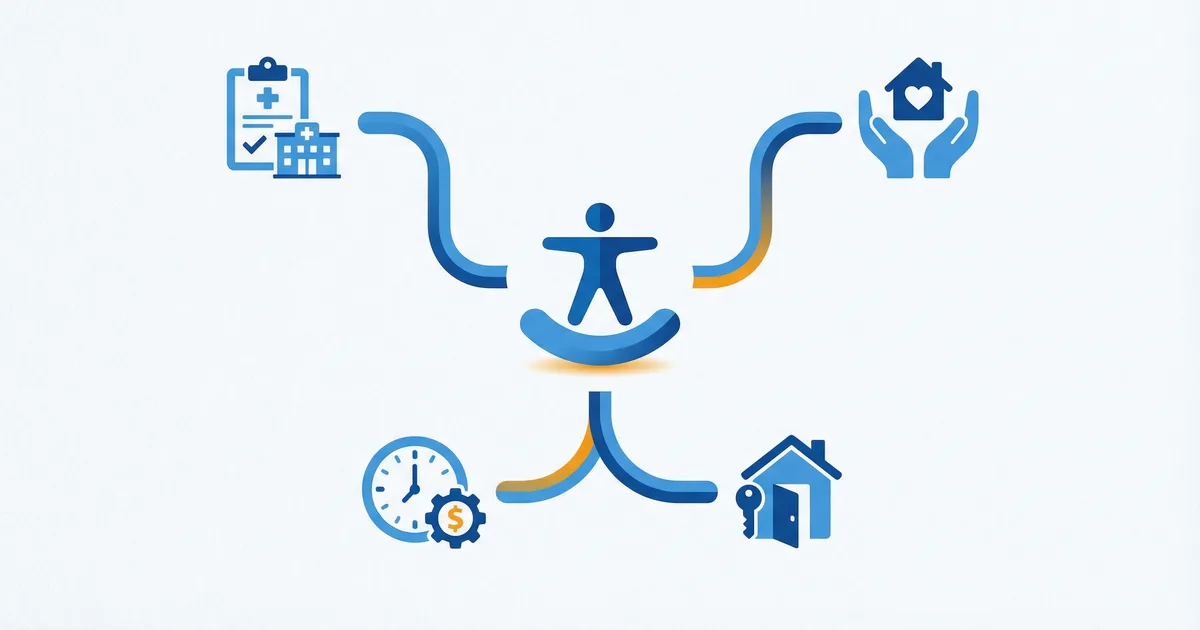
Poor balance is often discussed as “fall risk.” That framing is accurate—but incomplete. For clinicians working in outpatient, community, and home-based settings, balance impairment is a systems-level cost driver: it predicts downstream utilization, accelerates functional decline, and amplifies caregiver and social burden—often before a patient experiences a sentinel fall.
National surveillance illustrates the scope of the problem. In 2020, an estimated 14 million U.S. adults aged ≥65 (27.6%) reported at least one fall in the prior year; in 2021, 38,742 older adults died from unintentional falls (78.0 per 100,000). The same CDC report notes that medical costs attributed to nonfatal and fatal falls in this age group are approximately $50 billion annually.1
If you’re a PT, PCP, geriatrician, or health system leader, the question is less “Are falls bad?” and more:
What are we actually paying for when balance fails—and where is the highest-leverage point to intervene?
This article breaks down the hidden costs of poor balance beyond the immediate fall event and connects those costs to practical, evidence-informed actions—especially the CDC’s STEADI clinical framework.
Executive summary (for busy clinicians)
- Balance impairment is not only a fall problem. It’s an early marker of multisystem decline that can precede avoidable disability, social withdrawal, and higher-cost care pathways.
- The economic burden isn’t confined to the ED. Costs compound through post-acute care, longer rehab trajectories, durable medical equipment needs, caregiver time, and loss of independent living.
- Fear of falling is itself a clinical and economic factor. It can trigger activity restriction, deconditioning, and reduced participation—creating a self-reinforcing spiral.2
- STEADI is a pragmatic starting point. Screen, assess modifiable risk factors, and intervene with matched strategies—especially strength + balance training and referrals when warranted.3
- Scalability matters. The best program is the one patients will do consistently for long enough to matter. Technology-supported, home-based practice can complement in-clinic care when paired with safety-first guardrails and clear escalation thresholds.4
1) “Beyond falls”: the real cost stack
When we talk about “fall costs,” we often default to acute care: ED visits, imaging, surgery, inpatient stays. Those are real. But the larger and more durable costs often accrue downstream and across domains:
A. Acute and post-acute utilization (the visible costs)
- ED evaluation, imaging, and observation
- Inpatient admission (fracture, TBI, complications)
- Surgical pathways (e.g., hip fracture fixation/arthroplasty)
- Post-acute care: SNF/IRF, home health, outpatient therapy
- Secondary complications: delirium, deconditioning, iatrogenic harms
CDC surveillance consistently shows that falls are common and fatal outcomes are substantial among adults ≥65.1 Cost analyses attribute billions annually to nonfatal and fatal falls.5
B. Functional decline and loss of independent living (the durable costs)
Even “non-catastrophic” falls (and near-falls) can precipitate a step-down in function. A patient who was borderline independent may become:
- a new assistive-device user,
- newly homebound,
- newly dependent for IADLs,
- or a candidate for a higher level of care.
This is the hard part to capture in a single ICD-10 code: balance impairment changes the patient’s life geometry—what environments they can navigate, what tasks they attempt, and what risks they tolerate.
C. The psychosocial cascade (the hidden costs)
Fear of falling is common and consequential. A foundational review (Age and Ageing) describes high prevalence and downstream effects including activity restriction and reduced participation.2 Clinically, that often means:
- fewer community outings,
- less walking (and therefore less conditioning),
- reduced balance challenge exposure,
- and a quicker slide into frailty.
When participation contracts, caregiver burden expands. Families absorb transport, supervision, home modification, and the emotional load of monitoring risk. These costs rarely appear in a claims line item—but they shape outcomes and adherence.
2) Poor balance as a “vital sign” for risk, not a single-diagnosis story
Balance is not a single attribute; it’s an integration problem across sensory, neuromuscular, and cognitive systems. That’s why balance tests (e.g., single-leg stance) can function as global health signals rather than single-condition diagnostics.
For example, a large cohort study found that inability to maintain a 10‑second one‑leg stance was associated with higher all-cause mortality over follow-up, even after adjustment (hazard ratio 1.84).6 Another U.S. cohort analysis (NHANES) linked balance dysfunction with higher all-cause and cause-specific mortality.7
These are observational signals—not deterministic forecasts. But in practice, they support a clinician-friendly conclusion:
When balance is poor, the odds that “something else is going on” are higher—and the cost of ignoring it is nontrivial.
From a systems perspective, balance impairment is often a gateway into higher-intensity care: falls, fear, inactivity, deconditioning, comorbidity amplification, and increasing support needs.
3) Why patients underreport (and why that matters economically)
Balance and falls are emotionally loaded. Patients may avoid disclosure because they fear losing independence, driving privileges, or housing autonomy. The CDC’s STEADI “talking with patients” materials emphasize non-judgmental framing and readiness-to-change approaches.8
Underreporting has direct economic implications:
- missed screening opportunities,
- delayed intervention until after injury,
- and missed chances to modify risk factors when change is easiest (before severe functional loss).
In other words: if falls are discussed only after the first serious injury, you’re paying the highest price for the smallest window of prevention.
4) A practical clinical pathway: STEADI (screen → assess → intervene)
STEADI exists because falls are common, costly, and preventable. The core workflow is simple:3
- Screen (annually, or after a fall)
- Assess modifiable risk factors and functional performance
- Intervene with matched strategies (exercise, PT, home safety, medication review, vision, footwear, etc.)
Screening: three high-yield questions
STEADI highlights three quick screening questions (at-risk if “yes” to any): fallen in the past year; feeling unsteady; worry about falling.3
Assessment: quick tests that map to action
STEADI includes practical, time-bounded assessments (e.g., Timed Up and Go; 30‑second chair stand; 4‑stage balance test) with thresholds that can prompt referral and targeted intervention.9
Intervention: match the strategy to the risk factor
STEADI’s strength is that it links risk factors to actionable interventions. For PTs and clinicians, the “highest-leverage” domain is often exercise that trains balance + strength with progressive challenge over time.
Evidence syntheses consistently support exercise (especially multicomponent programs) to reduce falls and improve balance outcomes in community-dwelling older adults.4
5) Making prevention scalable: where clinic care and home practice meet
Two implementation truths are hard to escape:
- The exercise dose required for durable fall-risk reduction is substantial. Many programs require months of consistent practice.34
- Capacity is limited. Visit counts, copays, transportation, staffing, and motivation constrain what’s feasible in-clinic.
That creates a natural hybrid model: use clinical encounters for risk stratification, technique, and progression planning; then rely on structured home practice and community programs to accumulate the dose.
STEADI’s recommended-programs materials are unusually explicit about what “dose” means in practice: programs intended to reduce falls should be progressive, focus on balance + strength, and be practiced for at least 50 total hours (e.g., 1 hour 3×/week for 4 months, or 1 hour 2×/week for 6 months).10
Technology can help—but only if it’s conservative, accessible, and clear about boundaries. For example, STEADI-aligned guidance can support:
- a safer “minimum viable” daily practice dose,
- clear stop rules and support requirements,
- and escalation prompts (e.g., recurrent falls, syncope, new neurologic signs).
Where SteadyUp fits (as a complement, not a substitute)
SteadyUp is designed as a safety-first, at-home balance training app for adults 65+. In provider terms, it can function as:
- an adherence tool for between-visit practice,
- a structured on-ramp for low-barrier balance activity,
- and a patient education artifact alongside STEADI counseling.
It does not replace a skilled evaluation, nor does it diagnose. Think of it as one more lever to increase dose and consistency—the two variables that most often fail in real-world prevention.
If you want a citation-first provider landing page (guidelines + evidence links), see: Why balance training? Evidence you can cite.
Share-ready resources (patient-friendly)
If you want something you can hand to a patient (or an adult child caregiver) that stays within safe, non-alarmist education:
- Balance Age test (quick self-check and education)
- Simple at-home balance tests (5 minutes; practical next steps)
- The 10-second test that predicts lifespan (and what to do next)
- Provider page (clearance checklist + education links)
6) Provider checklist: high-yield actions with low workflow friction
If you want a “do this Monday” plan:
- Normalize the conversation. “Falls are common and preventable” beats “Don’t fall.” Use non-judgmental language.8
- Screen every year. Use STEADI’s 3 questions; document fall history and near-falls.3
- Assess function, not just symptoms. Use one quick standardized test (TUG, chair stand, 4‑stage).9
- Intervene early. Balance + strength exercise with progressive challenge; consider PT referral for gait/balance; address home hazards, vision, footwear, and medication side effects via appropriate channels.34
- Plan for adherence and dose. Give patients a simple, safe, trackable home plan—and a follow-up interval that treats balance like a trainable vital sign. If your intervention is “falls reduction,” plan the months-long runway needed to accumulate meaningful practice time (often framed as 50+ hours).10
Bottom line
If we only measure balance after an injury, we end up paying for fractures, hospitalizations, fear-driven deconditioning, and avoidable loss of independence.
If we treat balance impairment as an early, modifiable signal—and we use pragmatic pathways like STEADI to screen, assess, and intervene—the economics and the outcomes both improve.
Balanse publishes evidence-backed education and builds SteadyUp, a safety-first balance training app for adults 65+. Our content is educational and not a substitute for professional medical advice.