


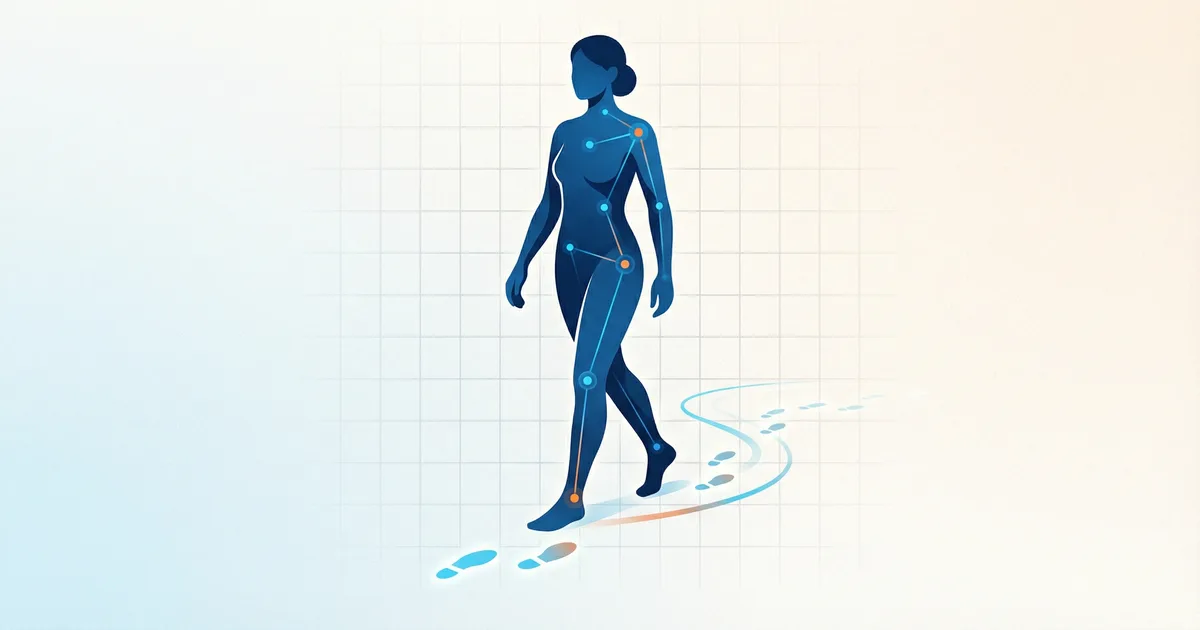
If you've ever walked through your home in the dark and still found the light switch, you can thank a quiet superpower called proprioception. It's the sense that tells your brain where your body parts are—without you looking.
Proprioception is sometimes called your body's "sixth sense." Not the spooky kind. More the "where are my feet right now?" kind. And when it’s a little off, it can feel like your internal GPS politely saying, “Recalculating…” right as you step off a curb.
Quick Answer
- What it is: Your built-in sense of body position and movement.
- Why it matters: It helps you catch a wobble early—before it becomes a stumble.
- What changes with age: Signals can get a bit quieter and slower over time.1
- Good news: Like strength, proprioception can improve with practice.2
- Safety first: Train near a counter or sturdy chair, and stop if you feel dizzy or unsafe.
Proprioception, in plain English
Your brain keeps you upright using three main “information streams”:
- Your eyes (what you see)
- Your inner ears (how your head is moving)
- Your body sensors in muscles, tendons, and joints (where your body is positioned)
That third one is proprioception. It’s how you can:
- Touch your nose with your eyes closed
- Step over a dog toy without staring at your feet the whole time
- Adjust mid-step when the sidewalk is uneven
Why proprioception matters for balance (especially on real-life surfaces)
In perfect conditions—bright room, flat floor, great shoes—balance can feel easy. But real life is messy:
- Dim lighting
- Thick carpet
- Gravel driveway
- A “helpful” grandkid leaving a Lego behind
When the environment gets tricky, your brain leans more on proprioception to keep you steady. If that signal is fuzzy, you may feel more cautious or unsteady than you used to.1
One reason researchers care about balance so much is that it reflects whole-body function. For example, a simple 10-second one-leg stand has been linked with long-term health outcomes in adults over 50.3 That doesn’t mean a single test predicts your future—but it does show that balance is a meaningful health signal.
Signs your proprioception could use a tune-up
These don’t prove anything on their own, but they’re common “hints”:
- You feel steadier when you look down at your feet
- Uneven ground (grass, gravel) feels surprisingly challenging
- You sometimes misjudge the last step on the stairs
- You feel “wobbly” when turning or changing direction quickly
If you’ve had a new or sudden change in balance, frequent falls, dizziness, numbness, or pain, it’s worth talking with a clinician or physical therapist.
5 simple, safe ways to train proprioception at home
These are meant to be gentle. Use a counter, sturdy chair, or hallway wall for support. A “light touch” is often enough.
1) The “tripod foot” reset (30 seconds)
Stand tall and feel three points on each foot: heel, big-toe base, little-toe base. Try to keep gentle pressure on all three.
Why it helps: It turns on foot awareness—your foundation for balance.
2) Slow weight shifts (1 minute)
Holding support, slowly shift your weight:
- Side to side (right foot → left foot)
- Forward and back (toes → heels)
Keep it smooth, like you’re moving a full cup of coffee without spilling.
3) Clock taps (1 minute per side)
Stand on your left leg with light support. Tap your right toes to the floor at: 12 o’clock (front), 3 o’clock (side), 6 o’clock (back), 9 o’clock (across). Switch legs.
Why it helps: Your standing leg learns to stabilize while the other leg moves—just like walking.
4) Heel-to-toe walk (10 steps)
In a hallway near the wall, walk heel-to-toe in a straight line for 10 slow steps. If you need, slide one hand along the wall.
5) Supported one-leg stand (10–20 seconds)
Stand tall, fingertips on the counter. Lift one foot an inch off the floor and hold. Switch sides.
When it feels easy, don’t rush to “no hands.” Instead, try:
- A lighter touch
- A longer exhale
- A slower, calmer posture
What the research says (in one paragraph)
Balance training works, even later in life. A large research review found that structured balance training can meaningfully improve balance performance in healthy older adults.2 And in a 12-week trial of older adults living in care facilities, adding proprioception-focused exercises improved balance and mobility measures compared with usual care.4
How SteadyUp fits in
Hands-free exercises are great for building body awareness. And tools can help you stay consistent.
If you want a simple way to track your balance over time, SteadyUp uses your phone’s sensors to help you:
- Measure your baseline steadiness
- See trends (not just “good days” and “bad days”)
- Build a short, safe practice habit
Want a great place to start? Pair this article with our guide: Simple Balance Tests You Can Do at Home.
This article is for general education and is not medical advice. If you feel unsafe, dizzy, or have new balance symptoms, stop and consider talking with a clinician.