


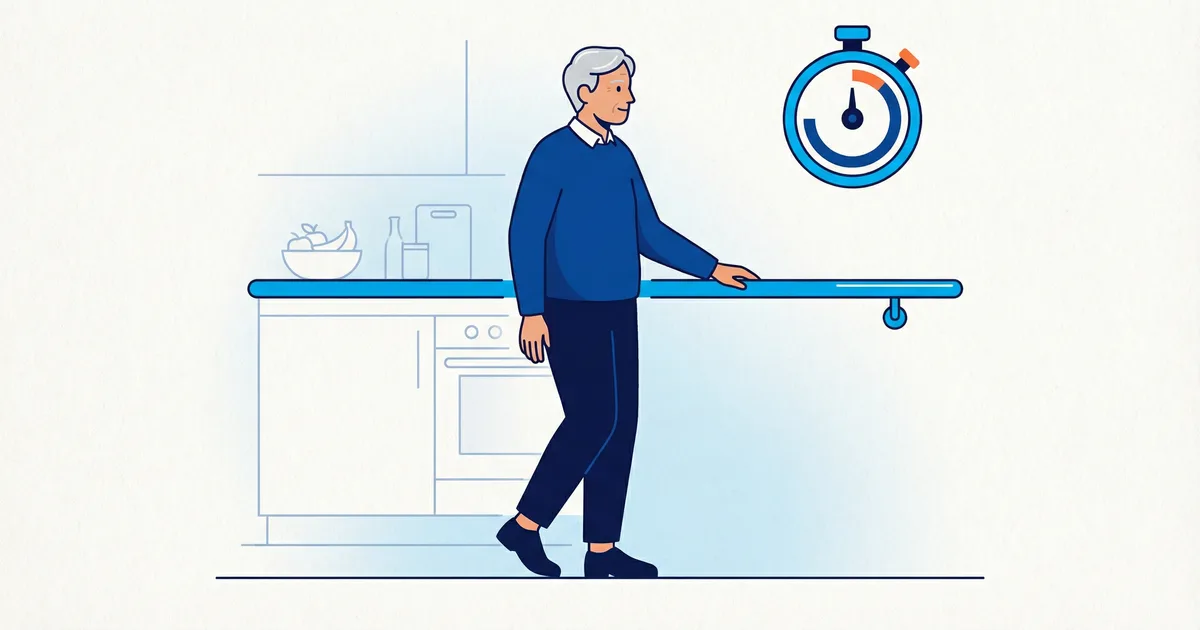
Early detection of balance problems can prevent falls and injuries. The good news is that you don't need expensive equipment or a doctor's visit to get a baseline understanding of your balance. With just a few simple tests, you can assess your current balance abilities and identify areas that may need attention.
Why Test Your Balance at Home?
Balance problems often develop gradually, making them easy to ignore until a fall occurs. Regular self-assessment can help you:
- Identify early warning signs before they become serious problems
- Track improvements as you work on balance training
- Know when to seek professional help from a healthcare provider
- Take proactive steps to prevent falls and maintain independence
Research shows that simple balance tests can be powerful predictors of future health outcomes. The ability to stand on one leg for 10 seconds, for example, is strongly linked to longevity and overall health1.
Safety First: Before You Begin
Before performing these tests, ensure your safety:
- Clear the area of obstacles, rugs, or slippery surfaces
- Have support nearby – stand near a wall, sturdy chair, or counter you can grab if needed
- Wear appropriate footwear – flat, non-slip shoes or bare feet
- Have someone nearby if you're concerned about your balance
- Stop immediately if you feel dizzy, unsteady, or uncomfortable
Test 1: The Single-Leg Stand Test
What it measures: Overall balance, leg strength, and proprioception
How to do it:
- Stand with your feet hip-width apart near a wall or sturdy surface
- Lift one foot off the ground, bending your knee to about 90 degrees
- Keep your standing leg straight and your arms at your sides
- Hold this position for as long as possible, up to 60 seconds
- Repeat with the other leg
How to score:
-
Excellent (Age 20-49): 43+ seconds
-
Good (Age 20-49): 40-42 seconds
-
Fair (Age 20-49): 25-39 seconds
-
Poor (Age 20-49): Less than 25 seconds
-
Excellent (Age 50-59): 40+ seconds
-
Good (Age 50-59): 35-39 seconds
-
Fair (Age 50-59): 25-34 seconds
-
Poor (Age 50-59): Less than 25 seconds
-
Excellent (Age 60+): 30+ seconds
-
Good (Age 60+): 25-29 seconds
-
Fair (Age 60+): 15-24 seconds
-
Poor (Age 60+): Less than 15 seconds
Red flag: If you cannot stand on one leg for at least 10 seconds and you're over 50, this may indicate an increased risk of mortality and warrants discussion with your healthcare provider1.
Test 2: The Romberg Test
What it measures: How much you rely on vision for balance
How to do it:
- Stand with your feet together and arms at your sides
- Close your eyes and maintain this position for 30 seconds
- Have someone time you and watch for swaying
How to score:
- Normal: Minimal swaying, able to maintain position for 30 seconds
- Concerning: Significant swaying or inability to maintain position
- Abnormal: Loss of balance or falling
What it means: If you sway significantly more with eyes closed, you may be overly dependent on vision for balance, which could indicate problems with your vestibular system or proprioception.
Test 3: The Tandem Walk Test
What it measures: Dynamic balance and coordination
How to do it:
- Find a straight line on the floor (or imagine one)
- Walk heel-to-toe along the line for 10 steps
- Keep your arms at your sides or crossed over your chest
- Look straight ahead, not down at your feet
How to score:
- Normal: Can complete 10 steps without stepping off the line
- Mild concern: 1-2 steps off the line or minor wobbling
- Moderate concern: 3-5 steps off the line or significant wobbling
- Significant concern: Cannot complete the test or frequent loss of balance
Test 4: The Get Up and Go Test
What it measures: Functional mobility and fall risk
How to do it:
- Sit in a standard chair with armrests
- Stand up without using your hands (if possible)
- Walk 10 feet at your normal pace
- Turn around and walk back to the chair
- Sit down
- Time the entire sequence
How to score:
- Low fall risk: Less than 10 seconds
- Moderate fall risk: 10-20 seconds
- High fall risk: More than 20 seconds
Test 5: The Four Square Step Test
What it measures: Dynamic balance and ability to step in multiple directions
What you need: Four canes, yardsticks, or tape to create a cross pattern on the floor
How to do it:
- Create a cross pattern dividing the floor into 4 squares
- Start in square 1, facing square 2
- Step into each square in sequence: 2, 3, 4, 1
- Then reverse: 4, 3, 2, 1
- Always face forward – don't turn your body
- Time how long it takes to complete the sequence
How to score:
- Low fall risk: Less than 15 seconds
- High fall risk: More than 15 seconds
Understanding Your Results
Green Light (Low Risk)
If you performed well on most tests, congratulations! Your balance appears to be in good shape. Continue with regular physical activity and consider adding balance-specific exercises to maintain your abilities.
Yellow Light (Moderate Risk)
If you struggled with one or two tests, it's time to pay attention to your balance. Consider:
- Starting a balance training program
- Discussing your results with your healthcare provider
- Addressing any medications that might affect balance
- Ensuring your vision and hearing are up to date
Red Light (High Risk)
If you had difficulty with multiple tests or couldn't complete some safely, please:
- Consult your healthcare provider about your balance concerns
- Consider a comprehensive balance assessment
- Implement immediate fall prevention strategies
- Begin supervised balance training
What Affects Your Test Results?
Several factors can influence your balance test performance:
- Medications: Many common medications can affect balance
- Inner ear problems: Infections or disorders can impact your vestibular system
- Vision issues: Uncorrected vision problems make balance more difficult
- Muscle weakness: Particularly in the legs and core
- Neuropathy: Loss of sensation in the feet
- Fatigue: Tiredness can significantly impact balance performance
- Anxiety: Worry about falling can actually increase fall risk
When to Seek Professional Help
Contact your healthcare provider if you:
- Failed multiple balance tests
- Have experienced recent falls or near-falls
- Feel dizzy or unsteady regularly
- Have noticed changes in your walking or balance
- Are taking medications that affect balance
- Have chronic conditions that can impact balance (diabetes, arthritis, etc.)
The Next Steps: Improving Your Balance
The good news is that balance can be improved at any age. Consider:
Professional Assessment
A physical therapist or healthcare provider can conduct more comprehensive testing and create a personalized program.
Balance Training Programs
Structured programs like tai chi, yoga, or specialized balance classes can be very effective.
Technology-Assisted Training
Apps and devices can provide real-time feedback and track your progress over time.
Home Exercises
Simple exercises like single-leg stands, heel-to-toe walking, and weight shifting can be done daily.
Conclusion: Knowledge is Power
These simple tests provide valuable insights into your current balance abilities. Regular self-assessment can help you catch problems early and take proactive steps to maintain your independence and quality of life.
Remember, balance is not fixed – it's a skill that can be improved with practice. Whether your results show room for improvement or confirm that you're doing well, the key is to stay active and continue challenging your balance system safely.
Don't let balance problems sneak up on you. Take five minutes today to assess where you stand, and take action to keep yourself steady for years to come.
Ready to improve your balance? Start with one safe test today, then build a tiny daily habit (2 minutes near a counter). Small practice adds up.