


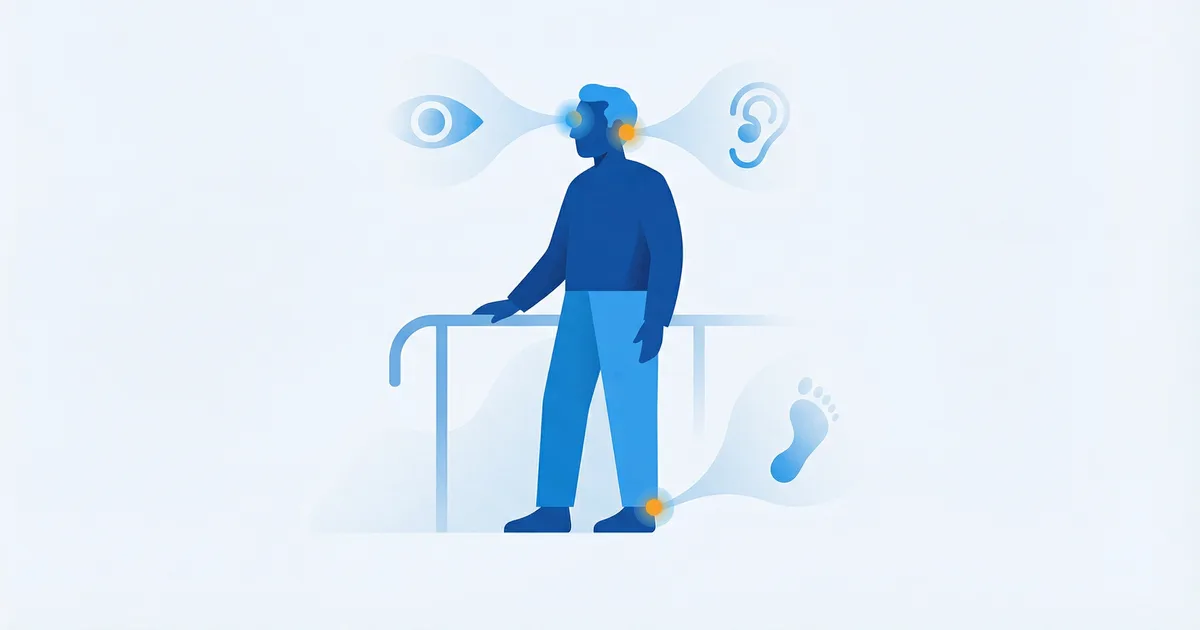
Have you ever wondered why your grandparents move more carefully than they used to? Or perhaps you've noticed yourself being a bit more cautious on stairs than you were a decade ago? You're not imagining things – balance really does change as we age. But here's the good news: understanding why this happens is the first step toward maintaining and even improving your stability throughout life.
The Surprising Truth: Balance Decline Starts Earlier Than You Think
Most people assume balance problems are something that happens "to old people." The reality is far more nuanced. Research published in Nature shows that balance begins to decline as early as our 40s – decades before most of us notice any changes1. This gradual process affects everyone, though at different rates and in different ways.
Think of balance like a savings account. Throughout childhood and young adulthood, we make deposits – building strength, coordination, and neural pathways. But starting in middle age, we begin making withdrawals. The key is understanding what causes these withdrawals and how to minimize them.
The Six Systems That Keep You Steady (And Why They Change)
Your ability to stay upright isn't controlled by a single system – it's an intricate dance between six different body systems. As we age, changes in each of these systems contribute to balance decline. Let's explore what happens and why.
1. Vision: Your Balance GPS Gets Foggy
Your eyes provide about 70% of the information your brain uses for balance2. They help you:
- Judge distances
- Spot obstacles
- Orient yourself in space
- Maintain a stable horizon
What changes with age:
- Decreased visual acuity: By age 60, most people need 3 times more light to see clearly than they did at 203
- Reduced depth perception: Makes judging steps and curbs more challenging
- Slower adaptation to darkness: Increases risk in dimly lit areas
- Development of cataracts or glaucoma: Can significantly impair visual input
Real-world impact: Remember how easily you used to navigate a dark movie theater? These visual changes make such tasks increasingly difficult, forcing other balance systems to work overtime.
2. The Vestibular System: Your Inner Gyroscope Loses Calibration
Deep within your inner ears lie tiny organs that act like a gyroscope, detecting head movement and position. This vestibular system is crucial for balance, especially during quick movements.
What changes with age:
- Hair cell loss: We lose about 40% of vestibular hair cells by age 704
- Reduced blood flow: Decreases sensitivity to movement
- Calcium crystal displacement: Can cause vertigo and dizziness
- Slower vestibular reflexes: Makes it harder to maintain stable vision during head movements
Real-world impact: That dizzy feeling when you stand up too quickly? It becomes more common as vestibular function declines, potentially leading to falls.
3. Proprioception: Your Body's GPS Signal Weakens
Proprioception – your sense of where your body parts are in space – relies on sensors in your muscles, joints, and tendons. It's what allows you to touch your nose with your eyes closed.
What changes with age:
- Reduced nerve sensitivity: Proprioceptive signals become weaker5
- Joint degeneration: Arthritis can impair joint position sensors
- Decreased muscle spindle sensitivity: Makes it harder to detect small movements
- Slower nerve conduction: Delays in sending position information to the brain
Real-world impact: Ever missed the last step because you thought your foot was already on the ground? That's proprioception failing to provide accurate information.
4. Sensation: The Foundation of Balance Crumbles
The ability to feel the ground beneath your feet is fundamental to balance. Your feet alone contain over 200,000 nerve endings that constantly send information to your brain6.
What changes with age:
- Peripheral neuropathy: Affects up to 20% of people over 607
- Reduced tactile sensitivity: Makes it harder to feel surface changes
- Decreased pressure sensation: Impacts weight distribution awareness
- Circulation problems: Can further reduce sensation
Real-world impact: Walking on uneven surfaces becomes challenging when you can't fully feel the terrain beneath your feet.
5. The Central Nervous System: Your Balance Computer Slows Down
Your brain and spinal cord process all the sensory information and coordinate muscle responses to keep you balanced. This complex processing requires split-second timing.
What changes with age:
- Slower processing speed: Reactions to balance threats take longer8
- Reduced brain volume: Particularly in areas controlling movement
- Decreased neurotransmitters: Affects signal transmission
- White matter changes: Disrupts communication between brain regions
Real-world impact: That extra moment it takes to catch yourself when you trip? That's your CNS taking longer to process and respond to the balance threat.
6. Musculoskeletal System: Your Balance Engine Loses Power
Muscles provide the power to maintain and recover balance. Without adequate strength, even perfect sensory input won't keep you upright.
What changes with age:
- Sarcopenia (muscle loss): We lose 3-8% of muscle mass per decade after 309
- Decreased muscle power: Explosive strength declines faster than regular strength
- Reduced flexibility: Limits movement options for balance recovery
- Bone density loss: Increases fracture risk if falls occur
Real-world impact: Getting up from a chair becomes harder, and recovering from a stumble requires more effort.
The Cascade Effect: Why Small Changes Lead to Big Problems
Here's where things get interesting – and concerning. These systems don't decline in isolation. When one system weakens, others must compensate. This creates a cascade effect:
- Visual decline → Increased reliance on vestibular and proprioceptive systems
- Vestibular problems → Greater dependence on vision (problematic in low light)
- Reduced sensation → Delayed balance corrections
- Muscle weakness → Inability to execute balance corrections
- Slower processing → All corrections happen too late
This interconnection explains why balance problems can seem to appear suddenly. In reality, multiple systems have been gradually declining until they reach a tipping point where compensation is no longer possible.
Beyond the Physical: Psychological Factors That Accelerate Decline
Fear of falling creates a vicious cycle that accelerates balance decline. Studies show that up to 50% of older adults who fall develop a fear of falling, and 25% of those who haven't fallen still fear it10. This fear leads to:
- Activity restriction: Less movement means weaker muscles and poorer balance
- Altered gait patterns: Overly cautious walking actually increases fall risk
- Social isolation: Avoiding activities limits balance-challenging experiences
- Depression and anxiety: Further reduces activity and motivation
The Hope: Your Balance Future Isn't Set in Stone
Now for the encouraging news: while some age-related changes are inevitable, the rate and extent of balance decline are highly modifiable. Research consistently shows that targeted interventions can not only slow decline but actually improve balance at any age11.
What the Research Shows Works:
- Balance-specific training: Can improve stability by 20-40% in just 12 weeks12
- Strength training: Particularly for core and lower body muscles
- Tai Chi: Reduces fall risk by up to 45%13
- Vision care: Regular eye exams and proper lighting
- Vestibular rehabilitation: Can significantly improve dizziness and stability
- Multisensory training: Challenges all balance systems simultaneously
Taking Action: Your Personal Balance Preservation Plan
Understanding why balance declines is powerful, but taking action is transformative. Here's how to start:
Immediate Steps (Do Today):
- Stand on one foot while brushing teeth: Start with 10 seconds, work up to 30
- Walk heel-to-toe: Practice in a hallway with a wall nearby
- Get up from chairs without using hands: Builds crucial leg strength
- Check your vision: Schedule an eye exam if overdue
Short-term Goals (This Month):
- Start a balance training program: Even 10 minutes daily makes a difference
- Assess your home: Remove trip hazards and improve lighting
- Review medications: Some can affect balance – discuss with your doctor
- Join a balance-focused class: Tai Chi, yoga, or specific balance training
Long-term Strategies (Ongoing):
- Make balance training a habit: Consistency is key
- Challenge yourself progressively: Balance improves with practice
- Stay socially active: Group activities provide natural balance challenges
- Monitor your progress: Track improvements to stay motivated
A Final Thought: Balance as a Skill, Not a Given
Perhaps the most important mindset shift is recognizing that balance isn't something you have or don't have – it's a skill that can be developed at any age. Just as you wouldn't expect to play piano well without practice, you can't expect to maintain excellent balance without training.
The changes that come with age are real, but they're not a death sentence for your stability. By understanding what's happening in your body and taking proactive steps, you can maintain the balance you need for the life you want to live.
Your Next Step
Knowledge without action is merely potential. Now that you understand why balance changes with age, it's time to do something about it. Whether you're 40 and want to get ahead of the curve, or 80 and looking to improve your stability, the best time to start is now.
Ready to take control of your balance health? Measure a baseline, then practice a little (safely, near support) most days. Track trends over weeks—not days.