


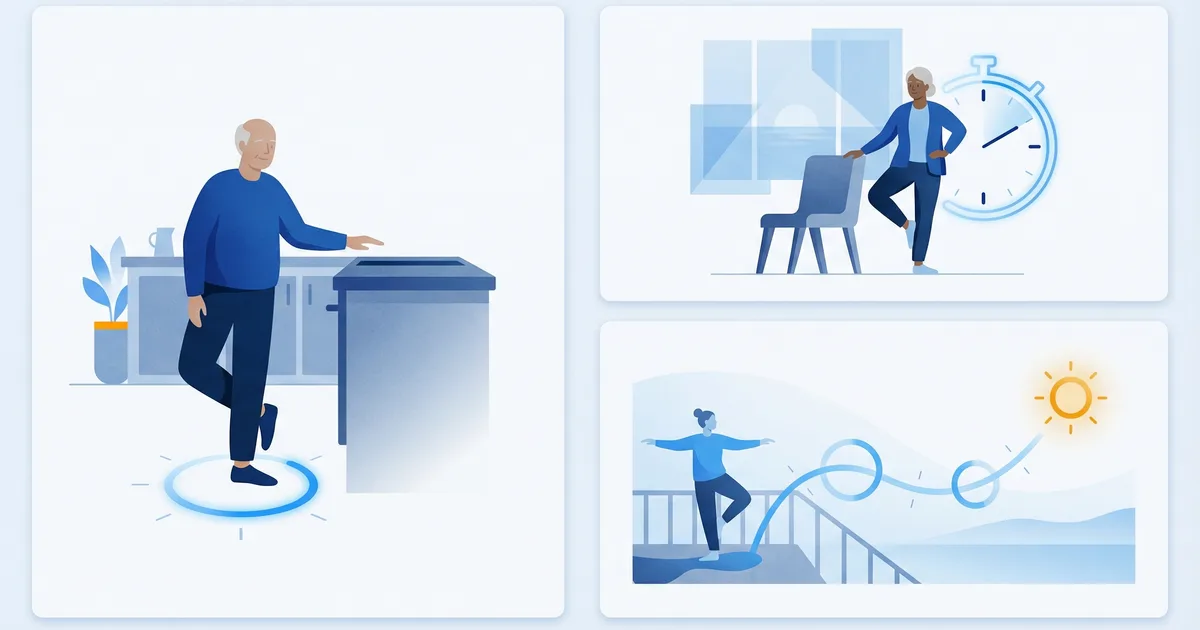
There’s a simple balance test you can do in 10 seconds—and in a large study, people who couldn’t pass it had a significantly higher risk of dying over the next several years1.
That’s a scary headline. But it’s also a hopeful one, because balance is trainable. A single test doesn’t define your future—it can simply be a strong signal that it’s time to pay attention.
Important: This article is for education, not medical advice. If you feel unsafe doing balance tests, don’t do them alone. Talk with your clinician or a physical therapist first.
Quick Take: What This Test Means
- What it is: Stand on one leg for 10 seconds, without holding on.
- Why it matters: In a 2022 study of adults ages 51–75, failing was linked to higher all-cause mortality over follow-up1.
- What it does not mean: It doesn’t “predict your death date,” and it doesn’t diagnose a disease.
- What to do with the result: Use it as a starting point—for safer habits, training, and (when needed) professional evaluation.
What Is the 10-Second Balance Test?
The test is a version of a one-leg stance:
- You stand tall.
- You lift one foot off the ground.
- You try to hold steady for 10 seconds.
It sounds almost too simple, but balance is a “whole-body” skill. In a few seconds, this test challenges multiple systems at once—strength, sensation in your feet, vision, your inner ear (vestibular system), and your brain’s ability to coordinate it all. (If you want the deeper science, see 6 Body Systems Critical for Balance.)
The Study Behind the Headline (Araújo et al., 2022)
Researchers followed 1,702 adults ages 51–75 for about 7 years. About 1 in 5 participants couldn’t complete the 10-second test1.
Here’s what made this study stand out:
- Those who failed the test had higher observed mortality during follow-up1.
- After adjusting for factors like age, sex, body mass index, and chronic conditions, failing the test was still linked to a higher hazard of death (adjusted hazard ratio 1.84, often described as 84% higher risk)1.
The numbers (simplified)
| Group in the study | Mortality over follow-up |
|---|---|
| Completed the test | 4.6% |
| Couldn’t complete the test | 17.5% |
Those percentages don’t mean “this will happen to you.” They describe what happened in that group of people, in that study. But the difference was large enough to grab the attention of the medical world—and it’s a strong reminder that balance is not “just a fitness detail.”1
How to Do the Test Safely at Home (Step-by-Step)
Safety checklist (do this first)
- Stand near a countertop or a sturdy chair you can grab if you wobble.
- Clear the floor: no rugs, cords, pets, or clutter.
- Use a well-lit space and a non-slip surface.
- If you’ve had recent falls, dizziness, fainting, or numbness in your feet—skip the test and talk to your clinician first.
The simple protocol
- Set up your “safety rail.” Stand next to a counter or chair, close enough to grab it.
- Start tall. Feet hip-width apart, eyes forward.
- Lift one foot. Keep your lifted foot off the ground. (Don’t rest it on your standing leg.)
- Start the timer. Hold for 10 seconds.
- Stop if needed. If you have to put your foot down or grab support, that attempt doesn’t count—but your safety does.
- Try up to 3 times. The study allowed up to three attempts1. Rest 15–30 seconds between tries.
- Test both sides. Many people have a “better” side.
What counts as a “pass”?
For a strict 10-second pass, you should be able to:
- keep the lifted foot off the ground for the full 10 seconds, and
- not hold onto anything.
If you brush the counter with one fingertip to stay safe, count it as “not yet”—and treat that as useful information, not a failure.
How to Interpret Your Result (Without Panic)
If you pass
That’s great. Don’t stop there—keep your balance “account” funded with a little practice each week.
Next steps:
- Try other simple screens in Simple Balance Tests You Can Do at Home.
- Build a routine with The Complete Guide to Balance Training for Seniors.
If you can’t pass today
Take a breath. Many people can’t—especially as they get older1. What matters is what you do next.
Next steps:
- Treat this as a training signal, not a verdict.
- Use support and start practicing safely (plan below).
- If you’re over 50, have other risk factors, or you’re worried—bring this up with your clinician or a physical therapist.
If the test feels unsafe
That result is even more important than the time. “Unsafe” is a strong cue to:
- prioritize fall-prevention basics at home, and
- get a professional balance assessment before pushing harder.
What This Test Can (and Can’t) Tell You
What it can tell you: This test is a quick “vital sign” for balance. In research, it’s a strong marker of overall health and resilience1.
What it can’t tell you: It can’t diagnose why your balance is worse. Common contributors include vision changes, medication side effects, foot sensation loss, inner ear issues, strength loss, and confidence changes. Sometimes it’s multiple things at once. (You can explore the “why” in Understanding Why Balance Declines with Age.)
A Simple 2-Week Plan If You Can’t Pass (Start Today)
The goal is not to “white-knuckle” a 10-second hold. The goal is to build skill safely and steadily.
Week 1: Make it safe and repeatable (2–4 minutes/day)
Do this near a counter:
-
Supported single-leg holds
- Lightly hold the counter with one hand.
- Lift one foot and hold for 10–20 seconds.
- Do 3 rounds per side.
-
Toe-tap balance
- Lift one foot, then lightly tap the toe down every few seconds.
- This teaches control without the fear of “one mistake = fall.”
- Do 30–45 seconds per side.
Week 2: Reduce support (still 2–4 minutes/day)
-
“Hover hand” holds
- Keep your hand hovering over the counter, not holding it.
- Try to get 5–10 clean seconds.
-
Add one small challenge
- Turn your head slowly left/right or
- Hold for 2 seconds, relax, repeat (mini-intervals)
If you want a full program (and lots of safer progressions), use The Complete Guide to Balance Training for Seniors. Exercise programs that challenge balance and strength can reduce falls in older adults, especially when practiced consistently over time2.
FAQs
Should I do the test barefoot or in shoes?
The Araújo study used a barefoot, eyes-open protocol1. For most people at home, barefoot on a firm, non-slip surface is a reasonable way to keep the test consistent. If being barefoot feels unsafe (cold floors, neuropathy, foot pain), use flat, non-slip shoes and focus on safety over “perfect protocol.”
Do I need to close my eyes?
No. The study’s 10-second test was done with eyes open1. Closing your eyes makes the test much harder and changes what you’re measuring.
What if I can do 7–9 seconds?
That’s a strong signal that you’re close. Treat it like a “near pass,” not a failure. Use the 2-week plan above and re-test in a safer way: up to 3 attempts, plenty of rest, and a counter within reach.
Can balance actually improve?
Yes. Balance is a skill that responds to practice. Reviews of fall-prevention exercise programs show that targeted training (especially balance + strength, progressed over time) can meaningfully improve stability and reduce falls for many older adults2.
What if I use a cane or walker?
If you rely on an assistive device for walking, don’t force a no-hands test just to “get a score.” Your best next step is usually a professional balance assessment and a training plan that keeps you safe.
Balance improves fastest when you can measure it and practice a little at a time. Small practice adds up. Two minutes today is better than “someday.”