


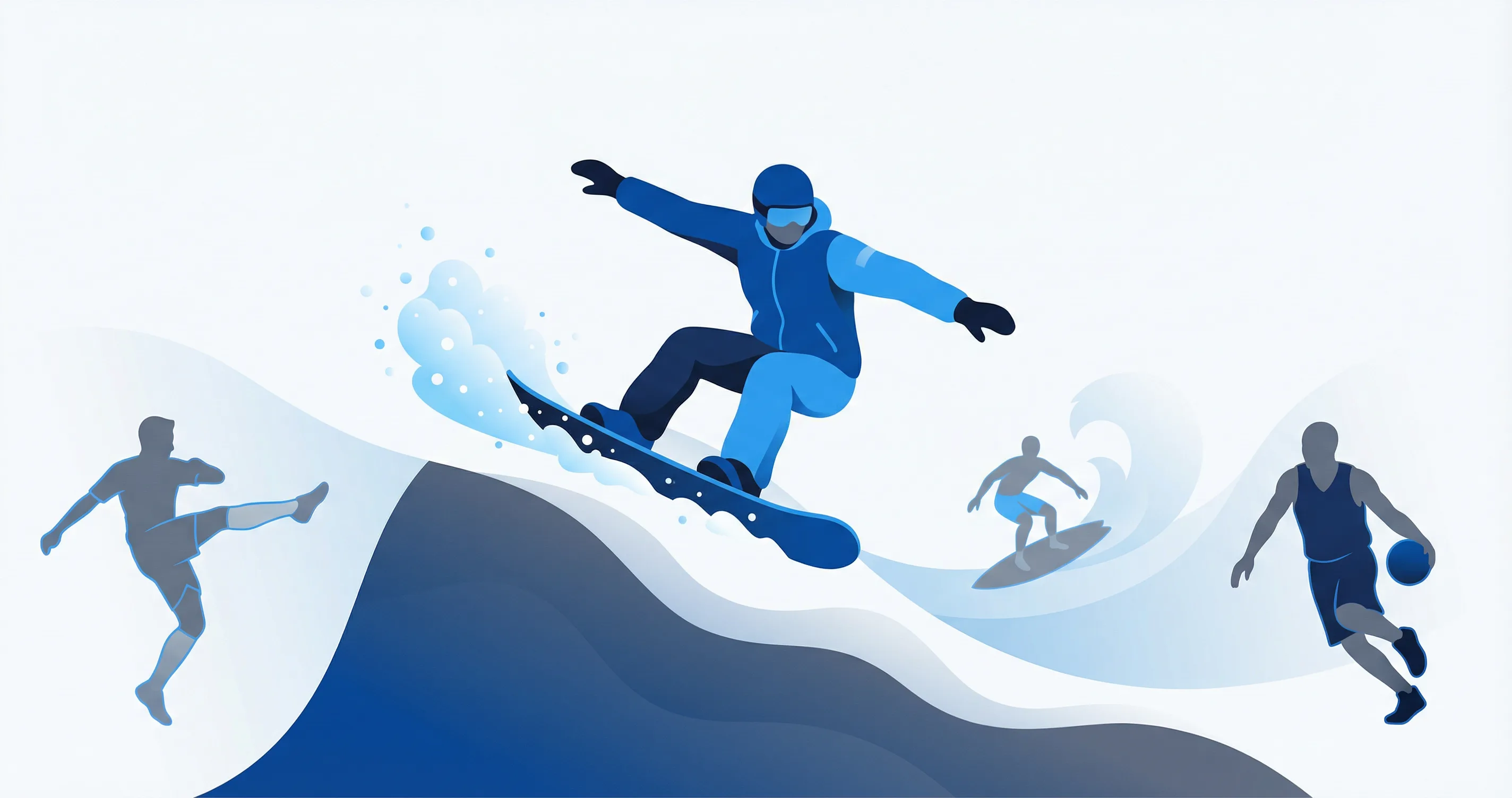
The best snowboarder on the mountain isn't the strongest. They're the one who reads terrain changes a split second faster, holds an edge through ice and powder on the same run, and absorbs landings so smoothly it looks effortless. The common thread? Balance.
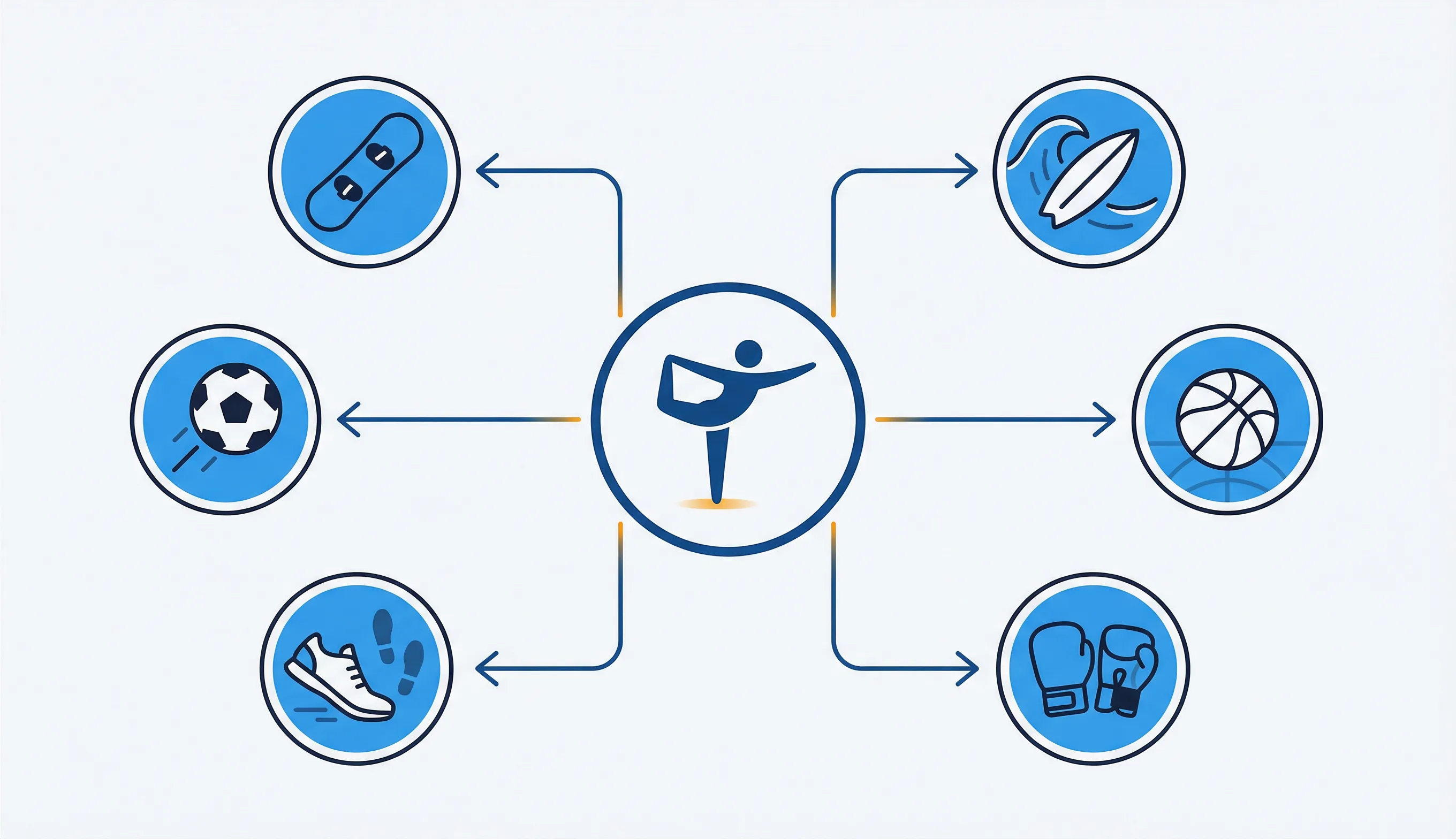
That pattern isn't unique to snowboarding. Across every sport—surfing, soccer, basketball, combat sports, even distance running—performance research keeps pointing to the same overlooked variable. Athletes who score higher on balance tests tend to perform better in their sport, and athletes who train balance specifically get measurably more powerful, more agile, and more resilient.1
This article covers the research, the sport-specific applications, and a no-equipment protocol you can start today.
This article is for education, not medical advice. If you have an existing injury, work with a qualified sports medicine professional before changing your training.
Quick Take
- A comprehensive review in Sports Medicine found that better balance scores correlate with better sport-specific performance across multiple disciplines—from alpine skiing and gymnastics to soccer and basketball.1
- Balance training improves rate of force development (how quickly muscles generate power), a key factor in sprinting, jumping, and cutting.2
- A systematic review of balance training interventions found significant improvements in postural control and functional performance in athletes.3
- Board sports—snowboarding, surfing, skateboarding—are essentially applied balance training. Off-season balance work transfers directly to on-snow and on-water performance.
- Meaningful gains show up in 4–6 weeks with three sessions per week of 10–15 minutes.
The Overlooked Performance Variable
Most athletes train the obvious: strength, speed, endurance, sport-specific technique. Balance rarely makes the program.
That's a mistake. Balance underpins every athletic movement. A sprint start, a jump landing, a defensive slide, a snowboard carve, a surfboard popup—all require rapid, unconscious control of your center of mass over a moving base of support. When that control falters, you don't just fall. You're slower, less precise, and less powerful even when you stay upright.
Hrysomallis (2011) reviewed the relationship between balance ability and performance across dozens of studies and sports. The finding was consistent: athletes with superior balance scores performed better in their sport, and the relationship was strongest in sports that demand rapid postural adjustments—exactly the movements that separate good athletes from great ones.1
What makes balance training different from other performance work is what it trains: the nervous system. Strength training builds bigger muscles; balance training builds faster communication between your brain, spinal cord, and muscles. Gruber and Gollhofer (2004) showed that sensorimotor training improved rate of force development—the speed at which muscles generate force—via neural adaptations, not muscle growth.2 That means faster first steps, higher jumps, and quicker reactions without added body weight.
Board Sports: Where Balance Is the Entire Game
Snowboarding and skiing
If you snowboard or ski, balance isn't a supporting skill—it is the sport. Every element of riding depends on dynamic balance:
- Edge control: Holding a carve through variable snow requires constant micro-adjustments at the ankle, knee, and hip. The better your proprioception (your body's internal sense of joint position), the more precise your transitions.
- Variable terrain: A single run can include ice, powder, crud, and groomed corduroy. Your balance system recalibrates continuously. Trained athletes adapt to surface changes faster because their neuromuscular pathways are more efficient.
- Landings: Absorbing impact while maintaining board control demands exceptional dynamic stability. The margin between a clean stomp and a blown edge is often a fraction of a second.
- Fatigue resistance: As muscles tire over a long day, balance degrades first. Athletes who have conditioned their balance systems maintain control longer because the neural pathways operate more efficiently under fatigue.
The off-season edge: Snowboarders and skiers face a unique constraint—their sport is seasonal. But balance training isn't. A structured off-season balance program lets you train the single most important skill for your sport year-round, without snow. When the season starts, riders who maintained balance work over summer consistently feel sharper from day one.
Surfing and water sports
Surfing shares snowboarding's demand for balance on a moving, unpredictable surface. The popup alone—going from prone to standing on a narrow, unstable board in under two seconds—is a pure balance test. Wave reading, bottom turns, and cutbacks all rely on the surfer's ability to shift their center of mass precisely and instantly.
Land-based balance training transfers directly to water performance because it strengthens the same neuromuscular pathways: proprioception, vestibular processing, and rapid postural correction.
Skateboarding
Skateboarding is a balance laboratory. Tricks, transitions, and basic cruising all require constant dynamic stability. Off-board balance training develops the body awareness and recovery reflexes that make new tricks more learnable and old ones more consistent.
Team and Field Sports
Balance training isn't exclusive to board athletes. Research shows strong connections between balance and performance in traditional team sports too.1
| Sport | Key balance demand | How balance training helps |
|---|---|---|
| Soccer | One-leg kicks, headers, tackles | Improved kick accuracy and power; better defensive positioning |
| Basketball | Cuts, rebounds, one-leg finishes | Faster direction changes; more stable landing from jumps |
| Football | Stance work, route running, tackling | Better lateral movement; harder to push off the line |
| Tennis | Split-step, lunges, rapid recovery | Faster court coverage; more stable shot platform |
| Combat sports | Strikes, clinch, ground transitions | Greater punch/kick power from a stable base; better takedown defense |
| Trail running | Uneven terrain, single-leg stance phase | Reduced ground contact time; better form under fatigue |
The pattern is consistent: if your sport involves unpredictable forces, rapid direction changes, or single-leg power production, balance training will improve your performance.
What the Research Shows
Three key findings from the balance-performance literature stand out.
1. Balance predicts performance
Hrysomallis's review found that competitive-level differences in balance ability track with competitive-level differences in sport performance. Higher-ranked gymnasts have better balance than lower-ranked gymnasts; the same pattern holds across alpine skiing, shooting sports, and team sports.1 Balance isn't a side effect of being skilled—it's a measurable component of it.
2. Balance training improves functional performance
Zech and colleagues (2010) conducted a systematic review of balance training interventions and found significant improvements in measures of postural sway and several functional performance outcomes.3 Balance isn't just something good athletes happen to have. It's trainable, and training it improves measurable results.
3. Neural adaptations drive the gains
The performance improvements from balance training come primarily from the nervous system, not muscle growth. Gruber and Gollhofer showed that sensorimotor training significantly improved rate of force development via changes in neural activation patterns.2 This is why balance training makes you more explosive without making you heavier: the same muscles fire faster and more precisely.
It also explains why balance training stacks well with strength work. Strength builds the engine; balance improves the wiring. Together, they produce a faster, more powerful, more controlled athlete.
A Performance-Focused Balance Protocol
This program is designed for athletes who already have a conditioning base. Perform it 3 times per week, either as part of your warm-up or as a standalone 10–15 minute session.
Phase 1: Neuromuscular foundation (Weeks 1–2)
| Exercise | Sets × Duration | Coaching cue |
|---|---|---|
| Single-leg stance, eyes open | 3 × 30 sec/side | Lock gaze on a fixed point |
| Single-leg mini squat | 3 × 8 reps/side | Slow descent, controlled return |
| Tandem stance with head turns | 3 × 20 sec/side | Slow, deliberate head rotation |
Phase 2: Dynamic challenge (Weeks 3–4)
| Exercise | Sets × Duration | Coaching cue |
|---|---|---|
| Single-leg stance, eyes closed | 3 × 15 sec/side | Arms relaxed at sides |
| Single-leg hop and stick | 3 × 6 reps/side | Stick the landing for 2 full seconds |
| Lateral single-leg hops | 3 × 6 reps/side | Small, controlled distance |
Phase 3: Sport-specific (Weeks 5+)
Adapt to your discipline:
- Board sports (snowboarding, surfing, skateboarding): Single-leg stance on a folded towel or pillow. Add simulated edge-to-edge weight shifts. Practice jump landings with a rotational component.
- Court and field sports: Reactive single-leg hops in multiple directions. Single-leg catches and throws. Eyes-closed balance after a sprint.
- Combat sports: Stance-specific balance holds. Single-leg kicks with return to balance. Partner perturbation training (light pushes during a balance hold).
Progression principle: If an exercise feels easy, it's no longer training your balance. Progress by removing visual input (eyes closed), adding movement (hops, rotations), adding load (medicine ball), or adding cognitive demand (counting backward while balancing).
Measuring Your Progress
Balance improvements show up in two ways: better sport performance (which you'll notice on the field or mountain) and better balance test scores.
A timed single-leg stance with eyes closed is a simple, repeatable baseline. Most young adults can hold 20–30 seconds; trained athletes often exceed 40. If you want a more detailed snapshot, our Balance Age assessment gives you a score in about 60 seconds.
For a deeper look at the body systems that drive balance—and where yours may have room to improve—see 6 Body Systems Critical for Balance. If you're also interested in the injury-prevention side, we covered that evidence in How Balance Training Prevents Sports Injuries: The 40% Solution.
📱 Enhance Your Training with SteadyUp
While these exercises are a great starting point, you can track your balance progress objectively with SteadyUp's daily assessments. Use the app to:
- Measure your baseline stability
- Track improvements over time
- Get personalized exercise recommendations
- Complement your training with real-time feedback on your stability
- Monitor your balance age and risk factors