


What if a single addition to your training routine could cut your injury risk by nearly half?
That's not a marketing claim—it's what a major 2022 research review found when scientists analyzed data from over 9,600 athletes1. The "addition" wasn't a fancy piece of equipment or an expensive recovery protocol. It was balance training.
This article breaks down the evidence, explains why it works, and gives you a no-equipment program to get started.
This article is for education, not medical advice. If you have an existing injury or condition, work with a qualified sports medicine professional before changing your training.
Quick Take
- A 2022 meta-analysis of 9,633 athletes found balance training reduced ankle injuries by 42% when used as a standalone intervention1.
- Broader neuromuscular training programs (which include balance work) lower the risk of lower-limb injuries by 39% and acute knee injuries by 54%2.
- Balance training improves proprioception, reaction time, and joint stability—the very systems that fail during common sports injuries3.
- You don't need equipment. A 10-minute routine, 3 times per week, is a realistic starting point.
The Research: What "40%" Actually Means
In 2022, Al Attar and colleagues published a systematic review and meta-analysis in the Journal of Physiotherapy, pooling data from nine randomized controlled trials. Here are the headline numbers1:
| Intervention | Ankle injury reduction |
|---|---|
| Balance training alone | 42% |
| FIFA 11+ program (includes balance) | 37% |
| All prevention programs combined | 36% |
The study covered 9,633 soccer players across 775,606 hours of exposure (training and match play), identifying 529 ankle injuries total. When athletes did balance exercises as their primary intervention—rather than as one piece of a larger warm-up—the protective effect was strongest1.
This wasn't a one-off finding. A separate systematic review by Hübscher and colleagues examined neuromuscular training across multiple sports and found a 39% reduction in lower-limb injuries overall, with an even more striking 54% reduction in acute knee injuries2.
Why these numbers matter for any athlete
Ankle sprains are the single most common injury in sports, accounting for roughly 15–30% of all athletic injuries depending on the activity. ACL tears, while less frequent, end seasons and sometimes careers. Even a modest reduction in these rates—let alone 36–54%—translates to thousands of athletes staying healthy and on the field.
And here's the part that often gets overlooked: balance training takes very little time and no special equipment, yet it addresses the root cause of many non-contact injuries.
How It Works: The Neuromuscular Edge
Balance isn't just "standing on one foot." It's a whole-body coordination skill involving six systems working together: vision, your vestibular (inner ear) system, sensation in your feet, proprioception (your body's position sense), your central nervous system, and your muscles. (For the full science, see 6 Body Systems Critical for Balance.)
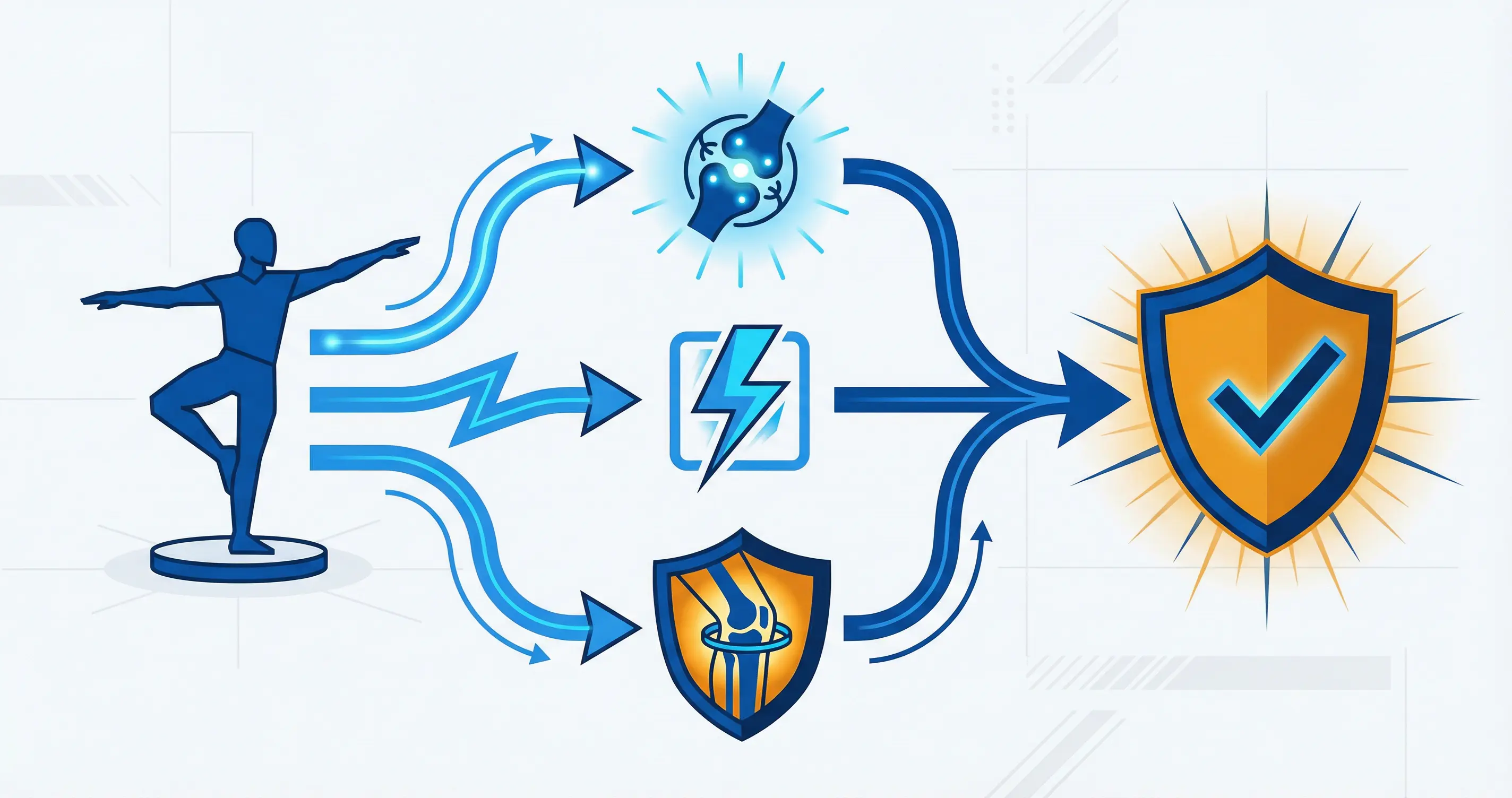
When you train balance, you're training all of these systems to respond faster and more accurately. Three key adaptations stand out:
Faster protective reflexes
Your ankle doesn't decide to roll—it happens in milliseconds. Balance training teaches the muscles around your joints to fire sooner when the body detects instability. Research shows that trained athletes activate stabilizing muscles significantly earlier in response to unexpected perturbations, closing the gap between "something went wrong" and "muscles caught it"3.
Improved proprioception
Proprioception is your body's internal GPS—the sense that tells you where your limbs are without looking. Athletes with better proprioception make more precise adjustments during cutting, landing, and pivoting. Balance training directly enhances this system, which is why it's a cornerstone of ankle-sprain rehabilitation as well as prevention3.
Greater dynamic joint stability
Controlled stiffness around the ankle and knee keeps the joint in a safe range during sudden forces. Balance-trained athletes show better dynamic joint stability, especially during the landing and deceleration phases where ACL injuries typically occur2. Think of it as training your joints to "self-correct" before you consciously realize something is off.
Sport by Sport: Where the Evidence Is Strongest
Soccer
The largest body of evidence comes from soccer. Balance training is already embedded in the FIFA 11+ warm-up program, used by national teams worldwide. The Al Attar meta-analysis focused specifically on soccer players and found the clearest injury-reduction signal in this population, with male players seeing the greatest benefit (42% reduction)1.
Basketball and court sports
Ankle sprains account for roughly 25% of all basketball injuries. Although fewer large-scale randomized trials exist specifically for basketball, the neuromuscular mechanisms are identical—rapid direction changes, jumps, and landings on unpredictable surfaces (including other players' feet). McKeon and Hertel's systematic review confirmed that balance training is clinically effective for both preventing and rehabilitating ankle instability, a chronic issue for court-sport athletes3.
Running and endurance sports
Runners don't cut or jump as much, but they accumulate enormous repetitive forces. Trail runners in particular benefit from improved proprioception on uneven terrain. And any runner with a history of ankle sprains has an elevated re-injury risk that balance training can meaningfully reduce.
Recreational and multisport athletes
Weekend warriors, CrossFit participants, recreational league players—if your sport involves change of direction, uneven surfaces, or jumping, balance training applies. The Hübscher review included athletes across a range of sports and still found a consistent protective effect2.
A Simple Starter Program (No Equipment Needed)
You don't need a wobble board or a clinic. Start with these progressions 3 times per week, spending about 10 minutes each session. Do them after your warm-up, when your muscles are active but not fatigued.
Weeks 1–2: Build the base
| Exercise | Sets × Duration | Notes |
|---|---|---|
| Single-leg stance (eyes open) | 3 × 30 sec per side | Stand near a wall for safety |
| Tandem stance (heel-to-toe) | 3 × 30 sec per side | Front foot determines the "side" |
| Single-leg mini squats | 2 × 8 reps per side | Quarter depth, slow and controlled |
Weeks 3–4: Add challenge
| Exercise | Sets × Duration | Notes |
|---|---|---|
| Single-leg stance (eyes closed) | 3 × 15–20 sec per side | Wall within arm's reach |
| Single-leg stance + head turns | 3 × 20 sec per side | Slowly turn head left and right |
| Forward/backward hops (single leg) | 2 × 8 reps per side | Small, controlled hops |
Weeks 5+: Sport-specific progression
- Soccer / basketball: Add lateral hops and cutting motions on one leg.
- Running: Try single-leg stance on an uneven surface (folded towel, grass).
- General: Progress to eyes-closed versions of any exercise you've mastered.
Key principle: If an exercise feels easy, make it harder. If it feels unsafe, scale it back. Consistent progression over time is what drives the neuromuscular adaptations that protect you.
When Balance Problems Signal Something More
If you consistently struggle with simple single-leg balance tasks—or notice one side is dramatically worse than the other—that's worth paying attention to. Asymmetries can indicate prior injuries that didn't fully heal, joint hypermobility, or sensory deficits that a sports medicine professional can assess.
For athletes over 40, balance testing also becomes a useful health marker beyond sport. Research links balance ability to long-term health outcomes, including longevity and overall functional fitness. If you're curious where you stand, our Balance Age assessment takes about 60 seconds.