


Ever turned your head quickly and felt that brief “whoa” moment—like your brain needed a second to catch up?
That’s your vestibular system.
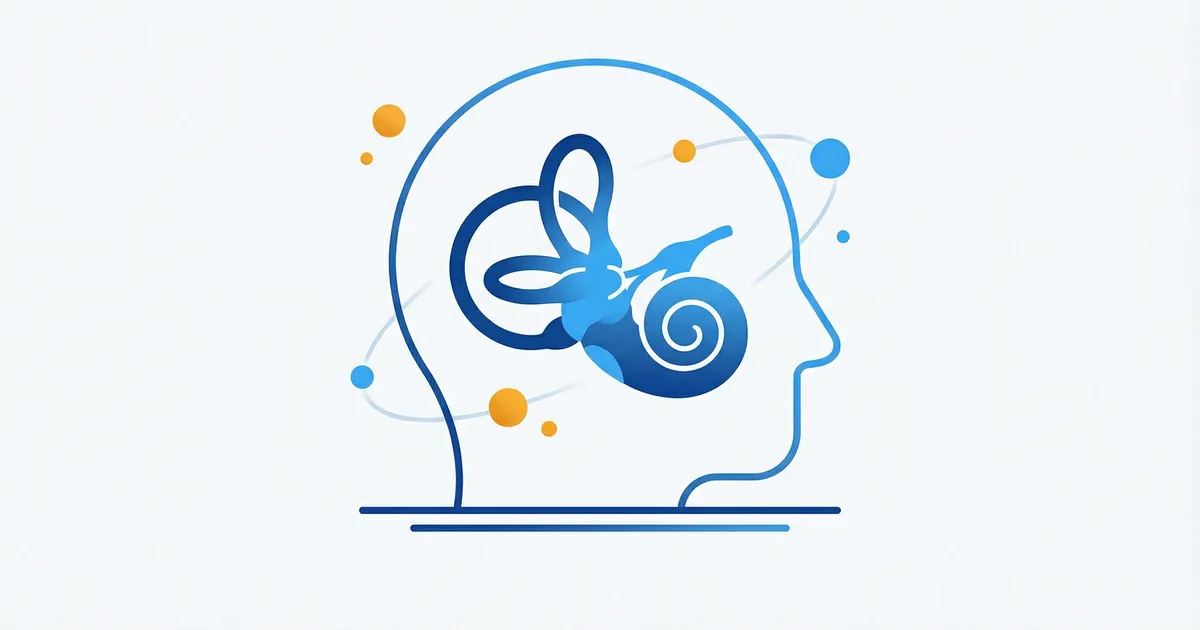
It lives in your inner ear, right next to the parts that help you hear. But its main role isn’t sound—it’s movement and orientation. It’s your body’s built-in motion sensor, quietly helping you stay upright when you:
- turn your head,
- look up or down,
- get up from a chair,
- walk on uneven ground.
A decent joke, promised: Your vestibular system is like your phone’s auto-rotate. When it works, you never think about it. When it doesn’t… everything suddenly feels sideways.
Important: This article is educational, not medical advice. If you feel unsafe, don’t practice balance exercises alone. If dizziness is new, severe, or worrying, talk with a clinician.
Quick Take (Plain English)
- What it is: Inner-ear sensors that detect head motion and gravity.
- Why it matters: It helps your brain keep you steady—and keeps your vision stable while you move.
- Good news: Balance is a skill. With safe practice, most people can improve.
How Your Inner Ear “Measures Motion”
Inside each inner ear, you have tiny structures that act like sensors:
1) Three “loops” that sense turning (rotation)
These are called semicircular canals. Imagine three tiny hula hoops filled with fluid, angled in different directions. When your head turns, the fluid shifts and bends tiny hair cells. Your brain reads that as “we’re rotating.”
2) Two “level sensors” that sense tilt and straight-line motion
These are called otolith organs. They help detect:
- tilting your head (like looking down), and
- straight-line motion (like starting to walk).
The Vestibulo-Ocular Reflex (The “Keep the World Still” Feature)
One of the vestibular system’s biggest jobs is to help stabilize your vision when your head moves. This is called the vestibulo-ocular reflex (VOR).
When you turn your head, your eyes automatically move in the opposite direction so your view stays clear—without bouncing.
If that reflex is sluggish, you might notice:
- turning your head quickly makes you feel unsteady, or
- the world feels a bit “jiggly” when you walk.
Why This Matters More With Age (And in Real Life)
Your brain is always combining three major signals to keep you steady:
- Vision (what you see)
- Body sense (proprioception) (what your feet, joints, and muscles feel)
- Vestibular (how your head moves relative to gravity)
When one signal gets less reliable, the others have to pick up the slack. For example:
- In dim light, vision isn’t as helpful.
- On soft or uneven surfaces, your feet get “noisier” information.
That’s why some people feel more wobbly on thick carpet, grass, or at night—even if they’re fine on a bright, flat sidewalk.
If you want the bigger picture, start here: 6 Body Systems Critical for Balance.
“Is This Vestibular?” Common Clues (Not a Diagnosis)
Many things can cause dizziness or unsteadiness (medication side effects, blood pressure changes, dehydration, vision changes, anxiety, and more). But vestibular issues often show up as patterns like:
- Spinning or “moving” feelings when you change head position
- Feeling worse with quick head turns
- Being much more unsteady with eyes closed or in low light
- Feeling off in places with lots of visual motion (crowds, scrolling screens)
If any of this is new or persistent, it’s worth discussing with a clinician or physical therapist—especially if you’ve had a recent fall.
What You Can Do (Safety-First and Actually Doable)
If dizziness is severe or sudden, skip this section and jump to “When to Get Help.” Otherwise, here are a few low-risk steps that help many people feel steadier.
1) Make the environment easier (this matters more than people think)
Before you “push” balance, make it safer:
- Stand near a countertop you can touch if needed.
- Use good lighting (especially for turning and stepping).
- Clear rugs, cords, and clutter.
- Avoid socks on slick floors (use bare feet on non-slip surfaces or non-slip shoes).
2) Add gentle head turns (only if it feels safe)
Because the vestibular system tracks head motion, small, controlled head turns can be a useful ingredient in balance practice.
Try this next to a counter, looking at a steady target (like a spot on the wall):
- Stand with feet hip-width apart.
- Look at the target.
- Slowly turn your head left and right 5 times.
- Stop if you feel dizzy or unsafe.
Keep it boring. Boring is safe.
If you want a full plan (with safe progressions), see: The Complete Guide to Balance Training for Seniors.
A Quick Note on Aging
The inner ear changes with age. Some studies suggest we lose a meaningful number of vestibular hair cells over time.1 Translation: your “motion sensors” can get a little less crisp—so good lighting, safe supports, and consistent practice matter even more.
Bottom Line
Your vestibular system is small, but it has a big job: keeping you oriented, steady, and visually stable while you move.
If it’s not working perfectly, you’re not alone—and you’re not stuck. Balance can improve with the right mix of safety, practice, and (when needed) professional guidance.
Want an easy next step?
- Try a simple self-check like the 10-Second Balance Test (safely, near support).
Small practice adds up. Keep it boring. Boring is safe.