

This article is educational and not medical advice. If you have sudden vision changes, new dizziness, or frequent falls, consider talking with a licensed clinician.
Balance is one of those things you only notice when it feels… off—like when you step into a dim hallway and your body does that tiny “whoa” moment.
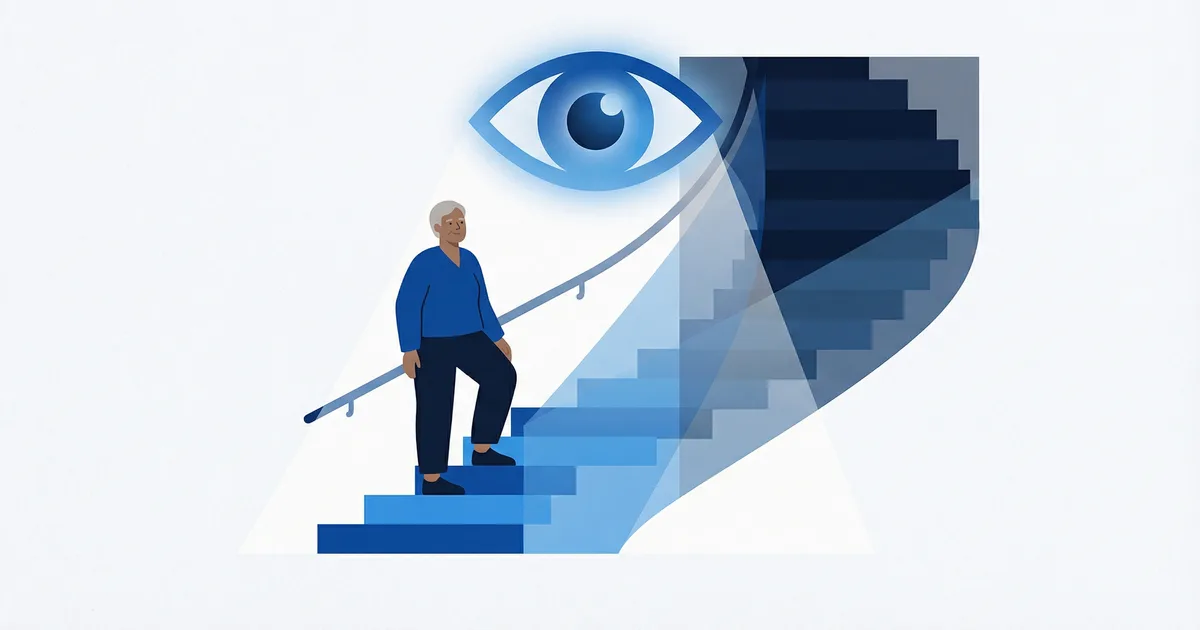
Here’s the surprising part: your eyes are a major balance organ. Not the only one—but a big one. If your nighttime trip to the bathroom ever feels like a surprise obstacle course, you’ve already met the “vision → balance” connection. (It’s usually not the furniture moving. It’s the lighting.)
Your balance team: three systems, one brain
Your brain keeps you upright by blending information from three main sources:
- Vision (what you see)
- Somatosensation (what you feel through your feet, joints, and muscles)
- Vestibular system (your inner ear’s motion + “which way is up?” sensor)
Think of it like a three-legged stool. If one leg gets wobbly—say, vision is limited—your brain leans harder on the other two. This is normal. It’s also why balance can feel very different from one situation to the next.
What your eyes actually do for balance (besides spotting the remote)
Your eyes help balance in a few practical ways:
- A steady reference point (“horizon”) helps your brain keep you oriented.
- Depth + edges help you judge stairs, curbs, and floor changes.
- Contrast helps you spot what’s “step” vs. “not step.”
- Motion cues help you detect small body sway.
Research in older adults shows that vision contributes meaningfully to postural stability—especially as other balance inputs change with age.1
Why balance feels harder with age (even if you “see fine”)
Many people can read the newspaper just fine and still struggle in real-life situations like:
- Dim lighting (restaurants, hallways)
- Glare (sun on shiny floors, headlights at night)
- Low contrast (beige carpet on beige stairs—designers, we need to talk)
- Quick light changes (bright outdoors → darker indoors)
Normal age-related vision changes can include needing more light, reduced contrast sensitivity, and slower adaptation between bright and dark environments.2 None of this means “something is wrong with you.” It means your balance system may be working with fuzzier visual signals—so the rest of the team has to pick up the slack.
A quick (safe) self-check: “How much do I rely on vision?”
This isn’t a diagnosis. It’s a simple way to notice patterns.
Safety first: Do this next to a kitchen counter (or sturdy surface). If you’re worried about falling, have someone nearby. Stop if you feel dizzy.
- Stand tall with feet together and hands hovering near the counter.
- Pick a steady target at eye level (a magnet on the fridge works).
- Hold for 20 seconds with eyes open.
- If that feels steady, close your eyes for 10 seconds (keep hands ready).
What it can tell you:
If you feel dramatically more wobbly with eyes closed, it may mean your brain leans heavily on vision in that setup. That’s common—especially in older adults—and it’s one reason lighting and visual targets matter.
If you want more at-home checks (done safely), see: Simple Balance Tests You Can Do at Home.
Make vision your “balance helper”: easy wins that work today
You don’t need fancy equipment. A few small changes can make your world easier to “read,” which makes balance easier too.
- Turn up the lights (especially at night). Night lights in the hall/bathroom help more than you’d think.
- Reduce glare. Shade harsh sun; avoid lights that bounce off shiny floors.
- Add contrast. The edge of steps is a great place for contrast tape.
- Clear the “walking lane.” Rugs, cords, clutter, and pets underfoot are sneaky.
- Use a steady visual target when you practice. “Eyes forward on one point” is a simple, powerful cue.
- Stay current on eye care. The CDC’s fall-prevention guidance includes vision as a common, modifiable risk factor (often as simple as keeping up with eye exams and updating lenses when needed).3
Train your balance without depending on perfect vision
The goal isn’t to “never use your eyes.” The goal is to build a balance system that works well even when vision is imperfect—like in dim light or on uneven ground.
Start simple and stay safe:
- Practice near support. Counter, wall, sturdy chair—use it.
- Progress one “knob” at a time. Narrow stance or softer surface or head turns (not all at once).
- Try a “small” vision challenge. Instead of eyes closed, use slightly dimmer light or a farther target.
- Stop if symptoms spike. Dizziness, nausea, or a “spinning” feeling is a reason to stop and reset.
Want the simplest next step? Build a tiny daily habit: 2 minutes of safe practice, repeated often, beats an occasional heroic workout. If you’d like structure and progress tracking, SteadyUp can help you measure your baseline and stay consistent with guided, safety-first sessions.
For more on how the whole balance system fits together, see: 6 Body Systems Critical for Balance.
Ready to feel steadier in the moments that matter—stairs, curbs, dim rooms, and busy days? Start with one safe check today, then build from there. Small practice adds up.